
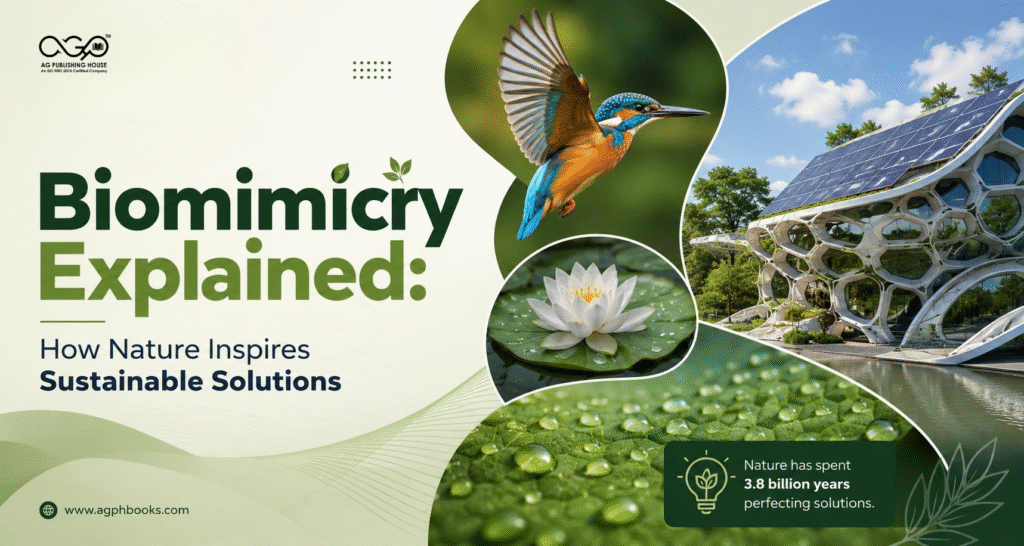
Nature has been solving problems for millions of years. Plants, animals and ecosystems have developed simple but effective ways to use resources, save energy, adapt to change and survive difficult conditions. Biomimicry is about learning from these natural solutions and using those lessons to solve human problems.
Think about the challenges we face today. We want buildings that use less energy, products that create less waste, materials that are stronger and lighter, and systems that use resources more carefully. Instead of always trying to invent a solution from the beginning, biomimicry asks us to look at nature and understand how it already handles similar challenges.
But biomimicry is not simply about copying the shape of a leaf, bird or animal. The real focus is on understanding how a natural system works and then adapting that idea to a human need.
This way of thinking can be useful in engineering, architecture, product design, energy, medicine and environmental management.
So, what exactly is biomimicry, how does it work, and what can we actually learn from nature? Let’s look at it step by step.
What Is Biomimicry? A Simple Explanation
Biomimicry means learning from nature to solve human problems. We study how plants, animals and natural systems work and then look for ways to use those ideas in our own designs, products and technologies. Nature has developed many ways to deal with problems such as movement, energy use, protection, resource use and survival.
But there is an important point to understand: biomimicry is not simply copying nature’s appearance.
For example, seeing the shape of a leaf and making a product that looks like a leaf is not enough. The more useful question is: Why does that leaf have that shape? What does it help the plant do? Biomimicry looks at the function, process or system behind a natural solution and then considers how that idea can be adapted to a human problem.
A Simple Way to Understand Biomimicry
Imagine an engineer has a problem with a product that uses too much energy.
Instead of only trying different materials or machines, the engineer can ask:
“Is there something in nature that performs a similar job using less energy?”
That question can lead to a different way of designing the product.
This is why the book describes nature as a source of knowledge, guidance and inspiration, rather than only a source of raw materials. Natural systems have developed through very long periods of adaptation, and many of them show efficiency, resilience and careful use of resources.
Why Is This Idea Becoming Important?
Today, we need solutions that don’t just work well but also use resources responsibly.
Biomimicry can help designers think about:
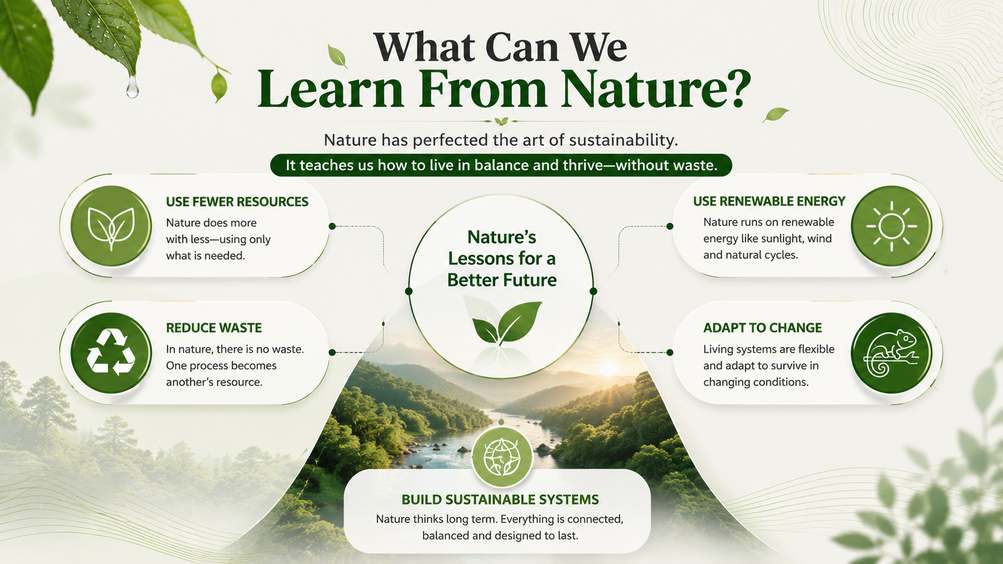
- How to use fewer resources
- How to reduce waste
- How to save energy
- How to make systems more adaptable
- How to create designs that work better with the environment
The goal is not to assume that nature has an answer for every problem. The goal is to look at how natural systems solve problems and learn from the principles behind them.
That simple change in thinking is what makes biomimicry useful – not only in science, but also in engineering, architecture, product design and sustainability.
Why Is Biomimicry Important for Sustainability?
One of the biggest reasons biomimicry is getting attention is its connection with sustainability. Today, we need to find better ways to use energy and materials, reduce waste and deal with environmental problems. Nature can give us useful ideas because natural systems have developed ways to survive while working with limited resources.
Think about a natural ecosystem. Materials and energy move from one part of the system to another. What is no longer useful to one organism can become useful to another. Natural systems also adapt when conditions change instead of depending on one fixed solution.
These ideas can help us rethink the way we design human systems.
How Biomimicry Can Support Sustainable Design
The book connects biomimicry with several important areas of sustainable design.
Using resources carefully:
Natural systems make careful use of the resources available to them. Designers can study these patterns and look for ways to reduce the amount of material or energy needed to make and operate a product or system.
Reducing waste:
Nature can teach us to think differently about waste. Instead of treating everything left over from one process as useless, we can ask whether it could become an input for another process.
Saving energy:
Natural systems often work efficiently within their surroundings. Studying these processes can provide ideas for designs that need less energy.
Building for change:
Nature is constantly dealing with changing conditions. Biomimicry encourages designers to think about adaptability and resilience rather than creating systems that only work under one set of conditions.
Biomimicry Is Not a Shortcut to Sustainability
It is important not to misunderstand the idea.
Using a natural shape or animal as inspiration does not automatically make a product sustainable. A nature-inspired product can still use too many resources or create waste.
The real question is:
Does the idea help us use resources more responsibly and work better with the environment?
That is where biomimicry and sustainability come together. The aim is to understand useful principles from nature and apply them carefully to human systems.
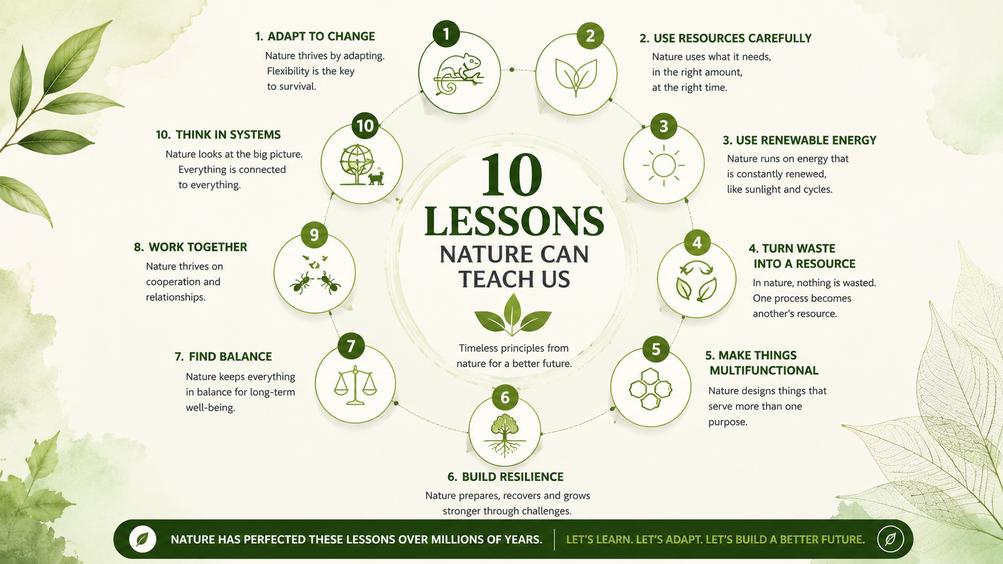
10 Principles of Biomimicry
Nature does not solve problems in just one way. Plants, animals and ecosystems use different strategies to survive, adapt and make the best use of what is available to them. By studying these strategies, we can find ideas that may help us design better products and systems.
The book highlights several important principles that can guide nature-inspired design.
1. Adapt to Changing Conditions
Nature is always dealing with change. Weather, temperature, food availability and other conditions can change over time.
A good design should also be able to respond to changing conditions instead of working well only in one situation.
2. Use Resources Carefully
Natural systems make use of the resources available to them. This gives designers an important lesson: can we achieve the same result while using less material, energy or other resources?
This approach can help reduce unnecessary consumption in products, buildings and infrastructure.
3. Use Renewable Energy
Nature gives us many examples of systems that depend on renewable energy. Learning from these systems can encourage designers to look for cleaner and more sustainable ways of producing and using energy.
4. Turn Waste Into a Resource
In nature, one organism’s waste can become useful to another. There is rarely a simple idea of “throwing something away.”
This gives us an important lesson for human systems: what we call waste may sometimes be a resource that can be used somewhere else.
5. Make One Thing Do More Than One Job
Natural structures often perform several functions at the same time.
This can inspire products and systems that do more without requiring additional materials or energy for every function.
6. Build for Resilience
Natural systems have to deal with disturbances and changing conditions.
Instead of designing something that works only when everything goes according to plan, we can think about how a product, building or system can adapt and recover when conditions change.
7. Look for Balance, Not Excess
More material, more energy or more technology does not always mean a better solution.
Nature often works with what is needed. This encourages designers to look for a balance between performance and resource use.
8. Learn From Cooperation
Nature is full of relationships. Organisms interact with one another and with their surroundings.
Studying these relationships can provide ideas for human systems where different parts need to work together rather than operate separately.
9. Value Diversity
Natural systems contain many different organisms and ways of responding to problems.
This diversity can help systems adapt to change and remain resilient.
10. Think About the Whole System
A product or technology does not exist by itself. It uses materials, energy and other resources, and it affects its surroundings.
Biomimicry encourages us to look beyond one part of a problem and understand how everything connects.
These principles show an important lesson: biomimicry is not about finding one natural object to copy. It is about understanding the ways natural systems work and seeing which of those ideas can be useful for human challenges.
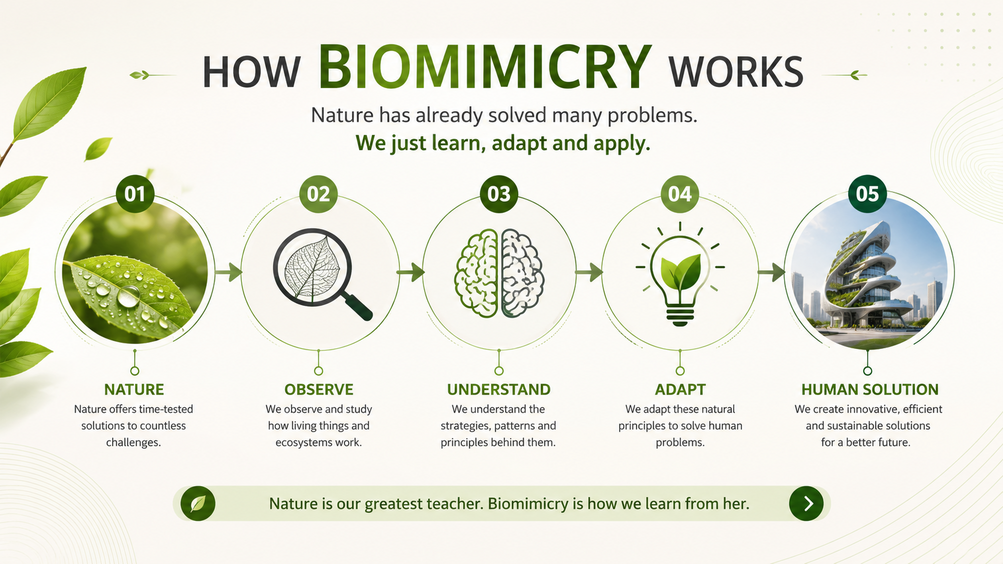
How Does Biomimicry Actually Work?
Knowing that nature can teach us useful ideas is one thing. The harder part is figuring out how to turn a natural idea into something that works for people.
Biomimicry is not a process of looking at an animal or plant and immediately copying it. It starts with a problem, followed by careful study, testing and improvement. The book explains that biomimicry research involves observation, analysis, experimentation and evaluation.
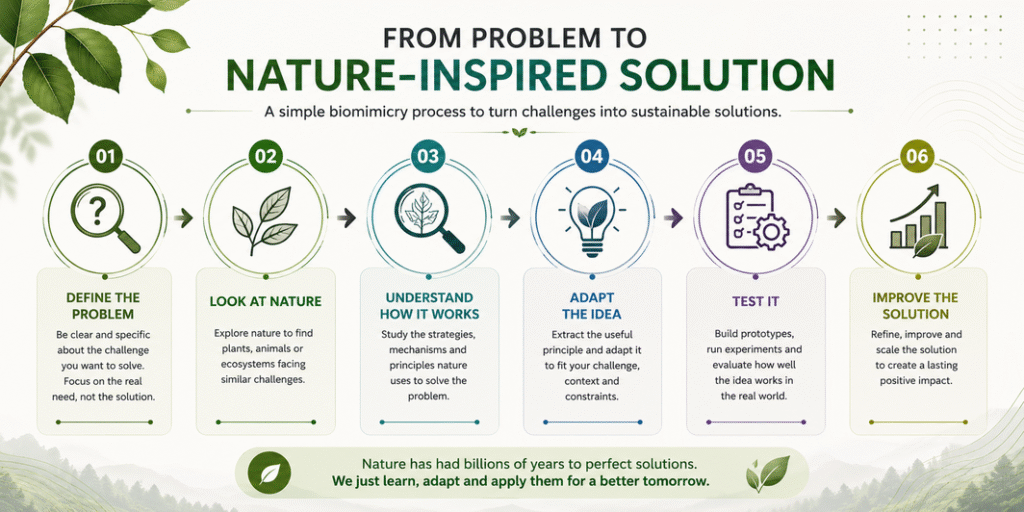
Here is the process in simple steps.
Step 1: Start With the Human Problem
First, clearly define what you want to solve.
For example, the problem might be:
- A product uses too much material.
- A building needs too much energy for cooling.
- A system produces too much waste.
- A machine needs to work more efficiently.
A clear problem makes it easier to look for a useful natural example.
Step 2: Look for a Similar Solution in Nature
Once the problem is clear, researchers look at plants, animals, organisms or ecosystems that deal with something similar.
The question is not:
“What animal looks like my product?”
It is:
“Does nature already deal with a similar problem, and how does it do it?”
Step 3: Understand How the Natural Solution Works
This is an important step.
Researchers need to understand the natural process properly before trying to use it. The book stresses that accurate biological understanding is important because natural systems can be complex.
Step 4: Turn the Idea Into a Design
Now the natural principle is adapted to a human need.
Biologists may explain the natural system, while designers and engineers work on how that idea could become a useful product, structure or technology.
This is one reason biomimicry is an interdisciplinary field. It brings together areas such as biology, engineering, design, environmental science and materials science.
Step 5: Test the Idea
A good idea still needs to be tested.
Researchers can use laboratory tests, computer simulations or prototypes to see whether the nature-inspired design actually works. Testing helps identify weaknesses and shows whether the natural principle really improves performance.
Step 6: Improve and Apply It
If the first version doesn’t work perfectly, it can be changed and tested again.
This is important because a natural solution may work extremely well in nature but behave differently when used in a human-made system.
In simple terms, the process is:
Human problem → Study nature → Understand the principle → Create a design → Test it → Improve it
That is what turns an interesting idea from nature into a practical biomimicry solution.
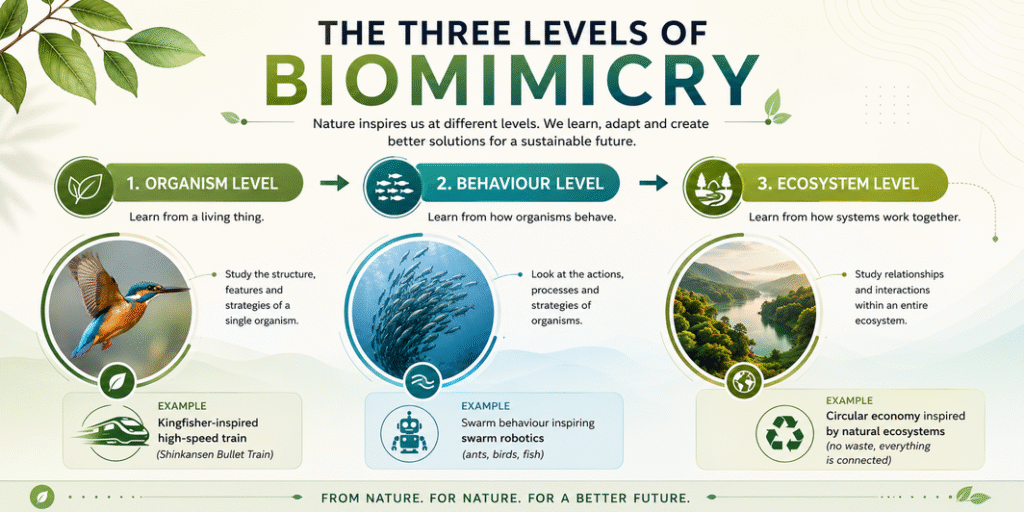
The Three Levels of Biomimicry
Not every nature-inspired idea works in the same way. Sometimes we learn from the physical features of one organism. Sometimes we study how organisms behave. And sometimes we look at how an entire ecosystem works.
The book explains these as three levels of biomimicry: organism, behaviour and ecosystem.
1. Organism-Level Biomimicry
This is the most direct level.
Here, designers study a particular plant, animal or other living organism and use one or more of its features as inspiration for a human design. This could be its shape, structure, surface or another physical characteristic.
One example from the book is the kingfisher-inspired train.
The idea came from studying the kingfisher and using what was learned from the bird to influence transportation design. The book also discusses how the streamlined shape of fish has influenced transportation and how plant seed attachment mechanisms have inspired fastening technologies.
2. Behaviour-Level Biomimicry
Here, the focus moves from what an organism looks like to what it does.
Researchers study how organisms communicate, cooperate, move, navigate or respond to their surroundings.
For example, social insects can organise themselves without one central controller. Birds can also coordinate their movements when travelling in groups. These behaviours have provided ideas for areas such as robotics, logistics, communication networks and management systems.
The important question at this level is:
“What can we learn from the way nature behaves?”
3. Ecosystem-Level Biomimicry
This is the broadest level.
Instead of studying one organism, researchers look at how an entire ecosystem works. They study relationships between organisms, energy flows, nutrient cycles and the way natural systems respond to change.
This level is especially useful when thinking about sustainability.
For example, natural ecosystems recycle resources, support diversity and work through many connected relationships. These ideas can inspire human systems such as circular economy models, sustainable development and environmental management.
The Simple Difference
You can remember the three levels like this:
Organism → What does it have?
Behaviour → What does it do?
Ecosystem → How does everything work together?
This shows how biomimicry can move from copying a useful feature to understanding the much bigger systems that make nature work.
Real-World Applications of Biomimicry
By now, the idea of biomimicry may sound interesting, but the real question is: Where can we actually use it?
The answer is in many areas. The book discusses applications in engineering, technology, materials, architecture, energy, water management, waste management and sustainable systems.
Biomimicry in Engineering and Technology
Engineers can study natural structures and processes to improve the way machines, materials and other technologies work.
For example, natural materials often have useful properties such as strength, lightness or flexibility. Studying these properties can help researchers develop new materials and products. The book also discusses applications involving surfaces, structures, movement, energy systems, sensors and robotics.
The benefit is not simply making something look like nature. The aim is to understand what makes the natural solution work and see whether that principle can improve human technology.
Biomimicry in Architecture
Buildings also need to deal with problems that nature faces every day—heat, airflow, sunlight, water and changing environmental conditions.
This is where nature-inspired design can give architects useful ideas. Natural structures and processes can be studied to develop buildings that respond better to their surroundings and use resources more efficiently.
The book places architecture among the important areas where biological knowledge can be applied to human design and sustainability.
Biomimicry in Product and Material Design
A product designer can ask a simple question:
“Can nature show us a better way to make this product?”
Researchers can study natural materials, surfaces and structures and then explore whether their useful properties can be reproduced or adapted.
This can lead to ideas for materials that are stronger, lighter or better suited to a particular purpose. The book highlights material science as an important part of biomimicry research because natural materials can have unique performance characteristics.
Biomimicry for Water and Waste Management
Nature can also teach us about cycles.
In an ecosystem, materials do not simply disappear after one use. They move through different parts of the system. This way of thinking can help researchers look for better approaches to water use, waste reduction and resource recovery.
Instead of asking only:
“How do we get rid of this waste?”
we can ask:
“Can this material become useful somewhere else?”
That change in thinking is closely connected to sustainable design and the circular economy.
Biomimicry and the Circular Economy
The connection becomes even clearer when we look at circular economy systems.
Natural ecosystems reuse resources through cycles. Biomimicry can help us study these relationships and think about human systems where materials remain useful for longer instead of becoming waste after one use. The book discusses this connection through circular systems and closed-loop approaches.
This is one of the most useful lessons biomimicry can offer:
A sustainable system should not only produce something efficiently; it should also think about what happens to the materials and resources after that stage.
So, whether the challenge involves a building, a product, a material, a machine or a larger system, biomimicry gives designers another way to look for solutions—by first understanding how nature handles similar challenges.
Nature as Model, Measure and Mentor
One of the simplest ways to understand the deeper idea behind biomimicry is through three words: model, measure and mentor.
These three ideas help us think about nature in a different way. Nature is not only something we observe or use. It can also teach us how to approach design and sustainability.
Nature as a Model
When nature is treated as a model, we study how natural systems work and use those lessons in our own designs.
For example, we may study how an organism uses energy, how a natural structure handles pressure or how a biological system manages resources.
The goal is not to copy nature exactly. It is to understand the useful idea behind it and see whether that idea can work in a human-made system.
Nature as a Measure
Nature can also act as a measure.
This means using natural systems to question whether our own solutions are truly sustainable.
Instead of asking only, “Does this product work?”, we can also ask:
- Does it use resources efficiently?
- Does it create unnecessary waste?
- Can it adapt to changing conditions?
- What happens to the system over the long term?
These questions help us look beyond short-term performance.
Nature as a Mentor
The third idea is nature as a mentor.
A mentor teaches us. In the same way, nature can teach us about efficiency, adaptation, relationships and the careful use of resources.
This changes the way we look at the natural world. We are not only asking what we can take from nature. We are asking what we can learn from nature.
That is an important part of the thinking behind biomimicry: nature is not just a source of materials or inspiration – it can be a teacher for better design and more responsible ways of solving problems.
What Makes Biomimicry Difficult?
It is easy to think that if nature has already solved a problem, we can simply copy the solution and use it. In reality, it is not that simple.
Natural systems can be very complex. A process that works perfectly inside a plant, animal or ecosystem may be difficult to reproduce in a factory, building or machine. The book points out that turning biological functions into practical technology can require a lot of research. Some natural processes are also difficult to reproduce under industrial conditions.
Understanding Nature Comes First
Before using a natural idea, researchers need to understand it properly.
This is why biomimicry often involves different areas of knowledge. Biologists may study the organism or natural process, while engineers, designers and materials researchers work out how the idea could be used in practice.
A Good Idea Still Needs Testing
Something that looks promising on paper may not work in the real world.
Researchers can use laboratory tests, computer simulations and prototypes to check how a nature-inspired design performs. Testing can reveal weaknesses and help improve the design before it is used more widely.
There can also be practical problems such as cost, limited resources, lack of expertise, infrastructure, regulations and environmental conditions.
So, biomimicry is not a shortcut.
The real process is:
Observe nature → Understand it → Adapt the idea → Test it → Improve it
That careful process is what turns an interesting natural idea into a solution that can actually work.
What Is the Future of Biomimicry?
Better Ways to Study Nature
New imaging and research tools can help scientists see biological structures and processes that were difficult to study in the past. The more clearly researchers understand how something works in nature, the easier it becomes to identify a useful principle that could be applied elsewhere.
The idea of learning from nature is not new, but the tools we have today are making it easier to study nature in much greater detail. This could open new possibilities for biomimicry in the years ahead.
The book points to several areas that are likely to become more important, including better biological research, digital modelling, sustainable applications and collaboration between different fields.
Computer Modelling Can Make Research Easier
Researchers can also use computer models to study natural processes under different conditions.
Instead of building and testing a physical model every time, they can first use a digital model to explore how a system might behave. The book notes that computational modelling can help researchers study complex systems more efficiently.
This area is continuing to develop. Recent research is also looking at how computational tools and biomimicry can work together to develop more sustainable designs.
More Focus on Sustainable Solutions
Environmental problems are likely to keep increasing the need for better ways to use resources.
The book expects future biomimicry research to focus strongly on sustainable applications because natural systems provide useful examples of resource management and efficient use of materials and energy.
More Collaboration Between Different Fields
A successful nature-inspired solution may require more than one type of expert.
A biologist may understand the natural system, an engineer may work on how to use the principle, a designer may make the solution practical, and a materials researcher may help choose the right material.
The book sees this kind of interdisciplinary collaboration as an important part of the future of biomimicry.
There is still a lot we don’t know about nature. That means the future of biomimicry is not only about improving existing ideas. It is also about discovering natural solutions that we have not yet understood.
How Can You Apply Biomimicry to a Real Problem?
You don’t have to be a scientist or engineer to understand the basic way of thinking behind biomimicry. The starting point is simply to look at a problem differently.
Instead of immediately asking, “What should we build?”, start by asking “Does nature already deal with a similar problem?”
The book explains that biomimicry research involves observing natural systems, studying how they work, testing ideas and then applying useful principles to human challenges.
You can use these five questions as a simple starting point:
1. What Problem Am I Trying to Solve?
Be specific. Don’t start with a product. Start with the problem.
For example:
“How can I reduce the amount of energy this system uses?”
is more useful than:
“I want to make a new machine.”
2. Does Nature Face a Similar Problem?
Look at plants, animals or natural systems that deal with a similar challenge.
3. How Does Nature Solve It?
Study the process rather than just the appearance.
Ask: What is actually making this natural system work?
4. What Can I Learn From It?
Find the useful principle and think about how it could relate to your problem.
5. Can That Idea Work in the Real World?
A natural idea still needs testing. It may need to be changed before it can work in a human-made product or system. The book stresses the importance of experimentation, prototypes and evaluation before practical use.
This gives you a simple way to remember the process:
Problem → Nature → Understand → Adapt → Test
That is the practical thinking behind biomimicry.
FAQs About Biomimicry
What is biomimicry in simple words?
Biomimicry means learning from nature to solve human problems. It involves studying how plants, animals and natural systems work and using useful ideas from them in human designs and technologies.
What is a simple example of biomimicry?
One example discussed in the book is the kingfisher-inspired train. Designers studied the bird and used lessons from its natural characteristics in transportation design. The book also gives examples of fish influencing transportation design and plant seed attachment mechanisms inspiring fastening technologies.
How does biomimicry help sustainability?
Biomimicry can help us think about using resources more carefully, reducing waste, improving efficiency and designing systems that can better respond to change. Natural systems provide useful examples of resource management and long-term balance.
What are the three levels of biomimicry?
The book explains three main levels:
- Organism level: learning from a specific plant, animal or organism.
- Behaviour level: learning from how organisms behave or interact.
- Ecosystem level: learning from how an entire natural system works.
These levels allow researchers to study nature at different depths, from a single feature to relationships across an entire ecosystem.
Is biomimicry the same as copying nature?
No. Simply copying the appearance of something in nature is not the whole idea. Biomimicry focuses on understanding the function, process or system behind a natural solution and then adapting the useful principle to a human problem.
Where can biomimicry be used?
The book discusses its use in areas such as engineering, technology, product design, architecture, materials, energy, water management, waste management and sustainable development.
What are the challenges of biomimicry?
Natural systems can be complicated, and a solution that works in nature may not be easy to reproduce in a human-made environment. Research, testing, technical knowledge, funding and collaboration between different fields may all be needed before an idea becomes a practical solution.
What is the future of biomimicry?
The book points to better biological research, advanced imaging, computer modelling, large biological databases, sustainable applications and stronger collaboration between fields as important areas for future development.
Conclusion: Nature Can Be Our Teacher
We often think of innovation as creating something completely new. Biomimicry gives us another way to think about it: sometimes, a useful solution may already exist in nature, and our job is to understand it.
From the way organisms use resources to the way ecosystems manage relationships, nature offers many ideas about efficiency, adaptation, resilience and balance. But using these ideas takes more than simply copying a natural shape. We need to study how the system works, understand the principle behind it, and then test whether it can solve a human problem.
This is also why biomimicry has potential in areas such as engineering, architecture, materials, technology and sustainable development. As research tools improve, we may be able to understand more natural systems and find new ways to apply what we learn from them.
The biggest lesson is simple:
Nature is not only something we can observe. It can also teach us how to solve problems differently.
And perhaps the next sustainable solution doesn’t always have to begin with inventing something new. Sometimes, it can begin with looking more carefully at what nature is already doing.
If you enjoy exploring ideas that connect science, innovation and the future, explore more ideas and insights from AGPH.