
You’ve spent months writing your book, editing it, and turning your ideas into something readers can actually hold in their hands. But before you publish, there’s one question worth asking: how do you protect your work? If you’re searching for how to copyright a book in India, the first thing to know is that copyright and ISBN are not the same. Copyright deals with the rights attached to your original writing, while an ISBN helps identify a particular book publication.
In this guide, we’ll cover the copyright registration process for books in India, who can apply, the documents you may need, government fees, registration timelines, and the difference between copyright and ISBN. The aim is simple: to help you understand the process without getting lost in legal or technical language.
Key Takeaways
- Copyright protects the original expression in your book.
- Copyright protection begins automatically when an original work is created.
- Registration is not compulsory, but it creates an official record of your claim.
- Authors can apply for copyright registration themselves.
- Both published and unpublished books can be registered.
- Copyright and ISBN serve two different purposes.
What Is Copyright for a Book in India?
Copyright is the legal protection given to an original creative work. For authors, this includes novels, poetry, biographies, academic books, and other original writing.
In simple words, copyright protects what you have written and how you have expressed it. It does not give you ownership of a general idea. The Copyright Office of India explains that copyright protects the expression of an idea, rather than the idea itself.
This is an important point to understand before learning how to copyright a book in India. You don’t copyright a basic thought or story idea. The protection applies to the original work you actually create.
What Does Book Copyright Protect?
Copyright gives the owner certain rights over the original work. These include rights related to reproduction, communication to the public, adaptation, and translation.
For example, if you write a novel, another person cannot simply copy your manuscript and publish it under their own name.
Your writing, descriptions, dialogue, characters, and other original parts of the manuscript can form part of the protected work.
Does Copyright Protect a Book Idea or Story Concept?
No. A general idea, concept, or story theme is not protected by copyright on its own.
Suppose you have an idea about a student who leaves a small town and moves to Delhi to build a career. Another writer can create a completely different story around a similar idea.
What matters is your original expression of that idea the actual words, scenes, characters, dialogue, and creative details in your manuscript.
Are Unpublished Books Protected by Copyright?
Yes. Your book does not have to be published before copyright protection can apply.
The Copyright Office confirms that both published and unpublished works can be registered.
So, if you’ve completed your manuscript but haven’t published it yet, you can still consider copyright registration.
It’s also a good idea to keep your original drafts and other records from the writing process. They can be useful if questions about authorship or ownership arise later.
Are e-Books Covered Under Book Copyright?
Yes. Copyright protection is not limited to books printed on paper. Original content published as an eBook can also fall under literary works.
Whether your readers access the work as a paperback, hardcover, or digital edition doesn’t change the basic principle of copyright protection.
Is Copyright Registration Mandatory for a Book in India?
If you’re learning how to copyright a book in India, one question usually comes first: do you actually have to register it?
The answer is no. Copyright protection does not depend on registration. For an original work, copyright comes into existence when the work is created. The Copyright Office states that no formality is required to acquire copyright.
Registration is a separate step. It gives you an official record of your copyright claim, which can be useful if there is ever a disagreement about ownership.
Does Copyright Exist Without Registration?
Yes. If you write an original novel, poetry collection, biography, or academic book, copyright can exist even if you never apply for registration.
For example, if you finish your manuscript today but plan to publish it next year, the fact that it is unpublished does not mean you have no copyright in your original work.
The Copyright Office also allows both published and unpublished works to be registered.
So, don’t think of registration as the moment when your copyright starts. It is better to think of it as a formal record of your claim.
Why Should Authors Register Copyright for a Book?
If registration isn’t compulsory, why should an author consider it?
The main benefit is having an official record connected to your work. The Copyright Office states that the registration certificate and entries in the Register of Copyrights can serve as prima facie evidence in court in copyright ownership disputes.
That can be useful if questions about ownership arise later.
Registration doesn’t guarantee that nobody will challenge your rights, and it doesn’t turn an ordinary idea into a copyrighted work. What it does is create a formal record that can support your claim.
Is Book Copyright Registration Worth It for First-Time Authors?
There is no rule saying every first-time author must register their book.
However, it can be worth considering if your book has significant commercial value, you’re planning wide distribution, several people are involved in its creation, or you want an official record of your ownership.
It’s also smart to keep your original drafts, dated files, agreements, and other records related to the creation of your manuscript.
In short: copyright protection can exist without registration, but registration can provide useful official evidence of your claim.
Who Can Register Copyright for a Book in India?
You don’t need to be a publishing company to register a book. If you’re the author and copyright owner, you can apply for registration yourself. The Copyright Office also allows eligible rights holders, assignees, and legal heirs to submit applications.
For authors, this makes book copyright registration in India possible even if you’re publishing independently.
Can an Author Register Their Own Book?
Yes. An author can apply directly instead of asking a publisher to do it.
If you’ve written a novel, poetry collection, biography, academic book, or another literary work, you can submit the application yourself if you have the relevant rights in the work.
This is especially useful for self-published authors who want to manage their own publishing decisions.
Can Two or More Authors Register One Book?
Yes. A book can have more than one author.
If you’re writing with a co-author, make sure the application correctly reflects the authorship and ownership arrangement. It’s better to agree on these details before submitting the application.
If the book is being created by several people, a written agreement can also help avoid confusion about who owns which rights.
Can a Publisher Register Copyright for a Book?
A publisher can assist with the registration process, but publishing a book does not automatically mean the publisher owns the copyright.
Copyright ownership can depend on the circumstances and the agreement between the author and publisher. Before signing a publishing agreement, pay attention to clauses covering copyright ownership, publishing rights, licensing, translation, adaptation, territory, and duration.
If you’re unsure about the legal effect of a contract, consider getting independent legal advice before signing it.
Can an Unpublished Book Be Registered?
Yes. You don’t have to publish your book before applying for registration. The Copyright Office confirms that unpublished works can also be registered.
For an unpublished literary work, make sure the title and author’s name are clearly mentioned on the submitted copy. The Copyright Office has specifically issued guidance on this point.
So, whether you’re a first-time author, co-author, or independent writer, the important thing is to clearly establish your authorship and rights before submitting the application.
How to Copyright a Book in India: Step-by-Step Registration Process
If you want to register your book yourself, you can apply through the official Copyright Office portal. For a straightforward literary work, the online process involves creating an account, completing Form XIV, uploading the work and required documents, filling the applicable particulars, making the payment, and saving the Diary Number generated after submission.
Step 1: Keep Your Manuscript and Details Ready
Before opening the application, keep these ready:
- Final manuscript
- Book title
- Author’s full name
- Applicant’s details
- Ownership details
- Required supporting documents, if applicable
- Active email address and mobile number
- Payment method
For a literary work, the Copyright Office currently instructs applicants to upload the work in PDF format, with the online instructions specifying a file size of less than 10 MB. Uploaded documents should not be password protected.
Do this first: Open your final manuscript and check that the title and author information are correct before you begin the application.
Step 2: Create an Account on the Official Copyright Portal
Go to the official Copyright Office website:
Copyright Office of India – Online Registration
On the page, select “New User Registration” if you don’t already have an account.
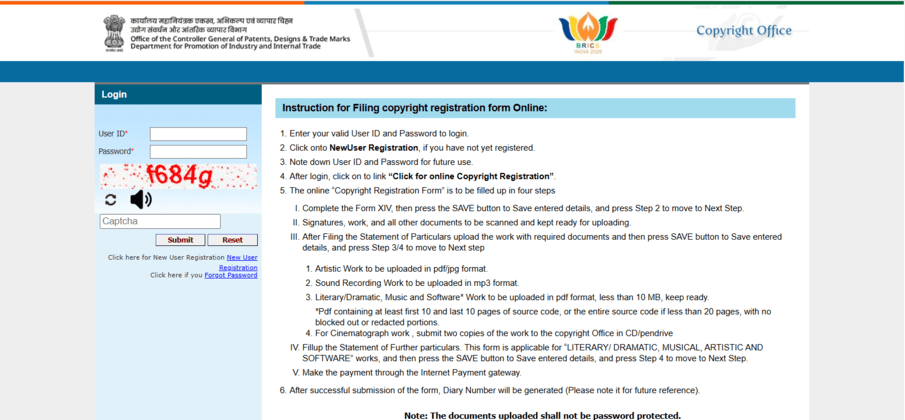
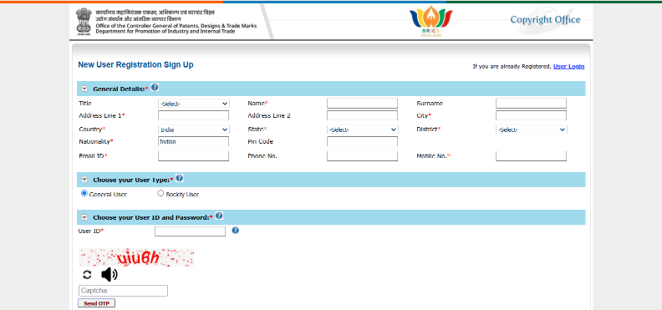
The official instructions ask new users to note down their User ID and Password for future use.
Practical tip: Use an email address you regularly check. You may need access to your account later to check the application.
Step 3: Start the Online Copyright Registration
After logging in, select:
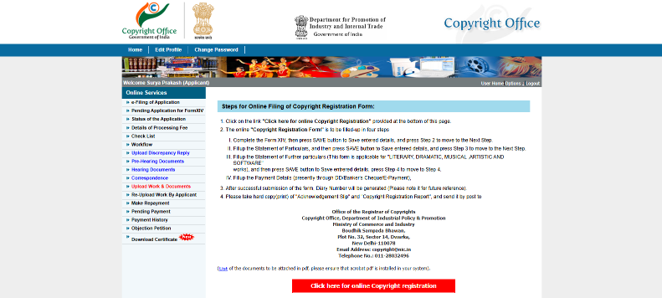
“Click for online Copyright Registration.”
The Copyright Office currently divides the online application into four main steps:
- Complete Form XIV
- Upload the work and required documents
- Complete the Statement of Further Particulars where applicable
- Make the payment
The portal then generates a Diary Number after successful submission.
Step 4: Step 4: Complete Form XIV
For a book, the relevant application is Form XIV.
The official Copyright Office provides the form as the application for registration of copyright.
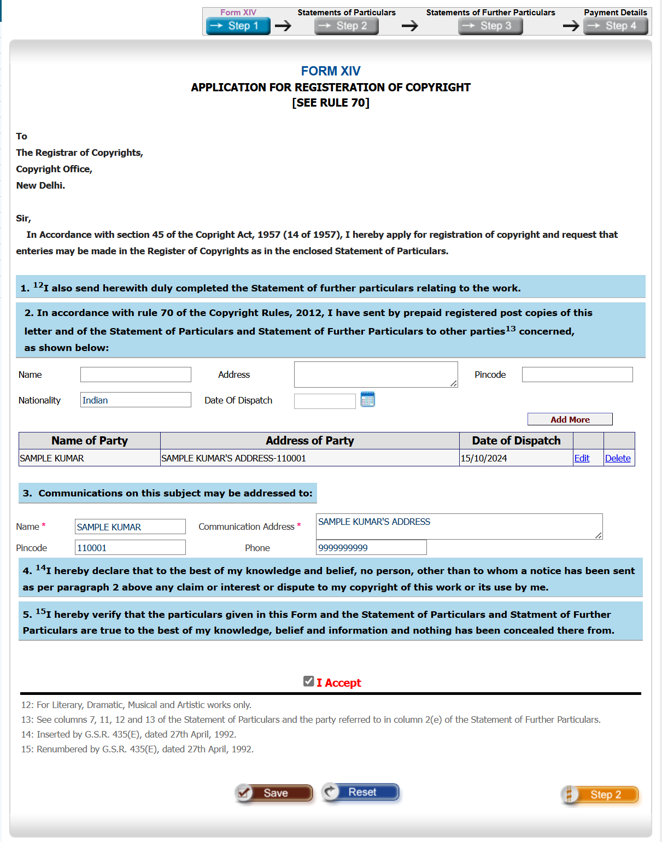
While filling it in, carefully check:
- Applicant name
- Author name
- Address
- Title of the work
- Nature/category of the work
- Ownership details
- Other required declarations
Don’t rush this step. The information in your application should be consistent with your manuscript and supporting documents.
Step 5: Complete the Statement of Particulars
The application requires the relevant Statement of Particulars.
This is where you provide information that identifies your work and the circumstances of your copyright claim.
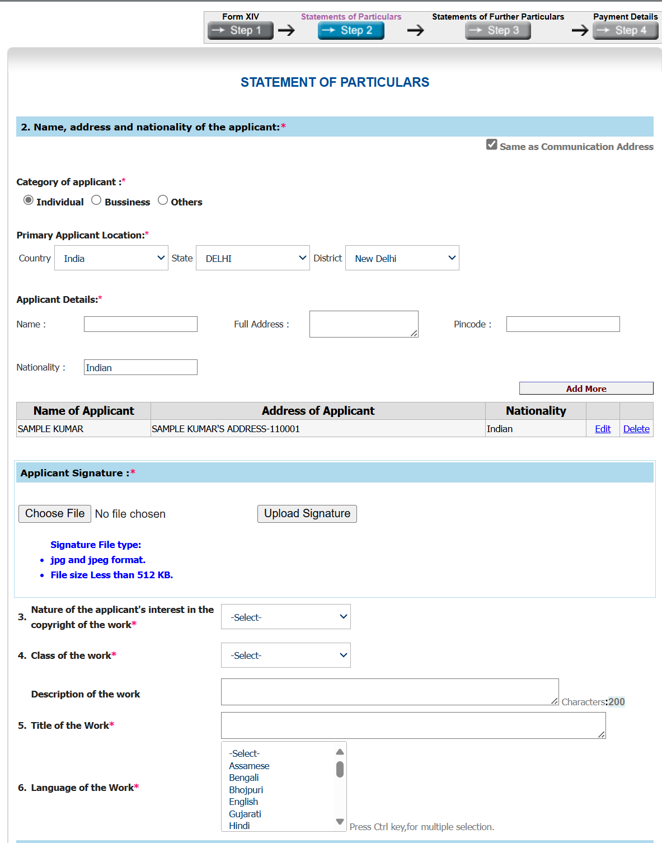
For example, you may need to provide information about:
- Title of the book
- Author
- Nature of the work
- Publication status
- Applicant’s interest in the copyright
The Copyright Office’s guidance says the columns in the Statement of Particulars and Statement of Further Particulars should be answered specifically.
Practical check: Before moving forward, read your answers once more and make sure they match your manuscript and ownership situation.
Step 6: Upload Your Manuscript and Required Documents
Now upload your book and the documents required for your application.
For literary works, the current online instructions specify PDF format and less than 10 MB.
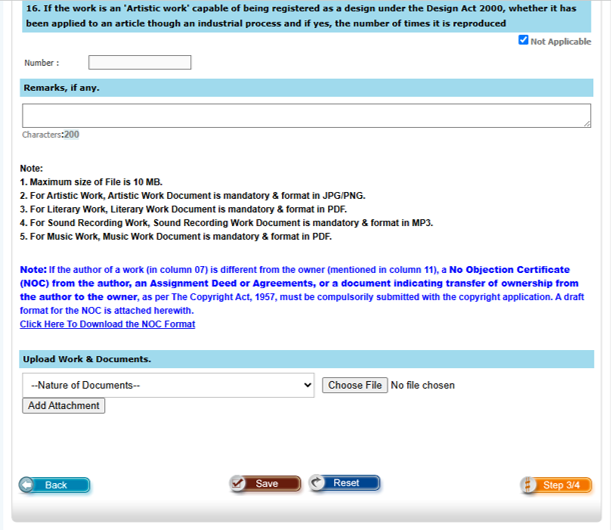
Before clicking Save, check:
Correct manuscript
Correct title
Correct author name
PDF opens properly
File meets the current size requirement
Required documents attached
Files are not password protected
Important: Requirements can change, so always check the upload instructions displayed on the official portal when you apply.
Step 7: Complete the Statement of Further Particulars
The Copyright Office’s online instructions state that the Statement of Further Particulars applies to literary, dramatic, musical, artistic and software works.
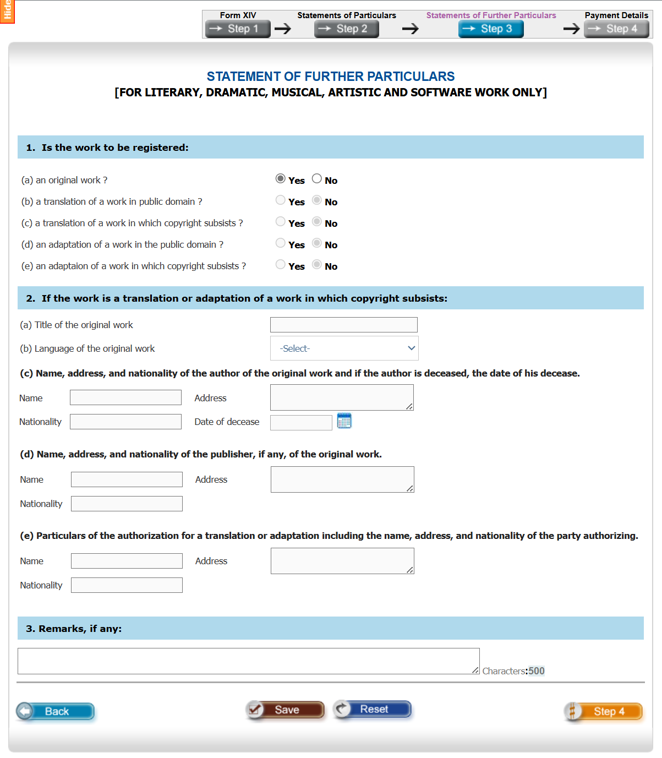
For a book, complete the relevant information carefully and save the form before proceeding.
If you are unsure about an ownership or rights-related question, don’t guess. Check the official guidance or seek appropriate professional advice.
Step 8: Pay the Copyright Registration Fee
After completing the required forms and uploading the work, make the payment through the online payment gateway.
The current fee schedule lists ₹500 per work for an application for registration of copyright in a literary, dramatic, musical or artistic work.
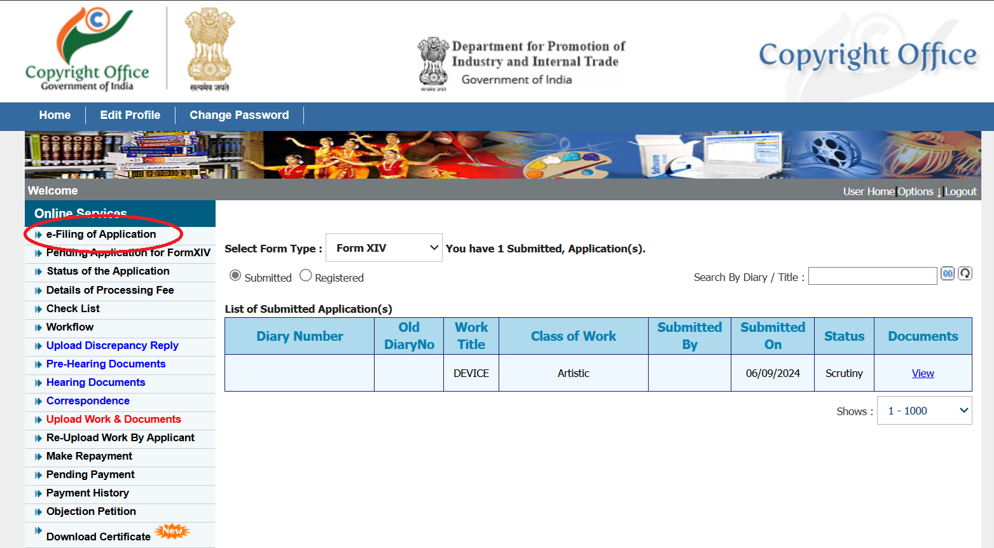
Practical tip: Save the payment confirmation immediately. Keep it in the same folder as your manuscript and application documents.
Step 9: Submit the Application and Save Your Diary Number
Once you have checked everything, submit the application.
According to the Copyright Office’s current online instructions, a Diary Number is generated after successful submission.
This is one of the most important things to save.
Immediately after submission:
- Take a screenshot of the confirmation.
- Copy the Diary Number.
- Save your payment receipt.
- Save a copy of your submitted information.
Do not rely on your browser history to find it later.
Step 10: Check Your Copyright Application Status
Once you have the Diary Number, you can check your application status through the official Copyright Office website.
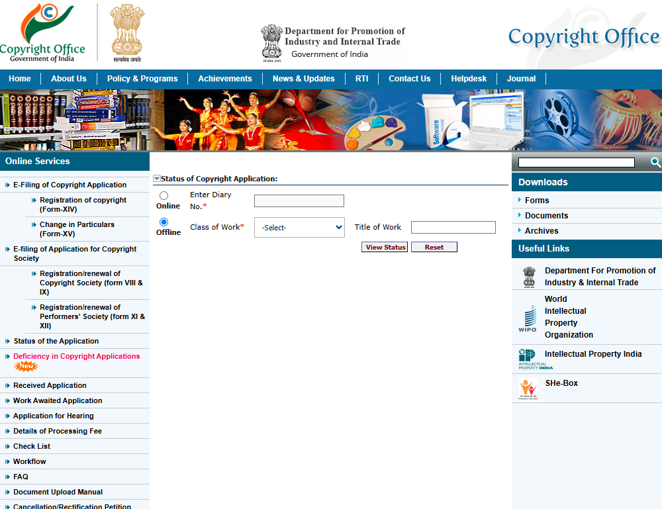
The current status page allows applicants to enter an Online Diary Number to check the status of an application.
The status system can show stages such as:
- Work Awaited
- Waiting
- Scrutiny
- Re-Scrutiny
- Pending for Hearing
- Hearing
- Registered
The official status descriptions are available through the Copyright Office system.
Step 11: Understand the Waiting Period
After filing, the application does not become registered immediately.
The Copyright Office status system identifies a mandatory waiting period of one month after payment, during which an application can be in the “Waiting” stage.
This is why authors should not assume that receiving a Diary Number means the registration certificate will be issued immediately.
What should you do?
Simply keep your documents safe and monitor the application status.
Step 12: What If There Is a Discrepancy?
Sometimes an application may require further information or correction.
If you receive a discrepancy communication:
- Read the issue carefully.
- Identify the information or document requested.
- Prepare the response.
- Submit it within the applicable period.
- Keep proof of your response.
Don’t ignore a discrepancy notice. The status system itself distinguishes applications where a discrepancy response has not been received and marks such cases as abandoned.
Documents Required to Copyright a Book in India
Before you start the application, keep the basic information and files ready. The exact requirements can vary depending on the ownership situation.
Manuscript or Copy of the Book
Keep the version of your book that you want to register ready in the format accepted by the Copyright Office portal.
Author and Applicant Details
Keep your full name, address and contact details ready. Make sure the spelling matches your official documents and application.
Ownership Documents
If you are not the sole author and copyright owner, you may need documents showing how the rights belong to the applicant.
For Joint Authors
If the book has multiple authors, make sure the application correctly reflects the authorship and ownership arrangement.
For an Unpublished Book
Follow the current Copyright Office instructions for submitting an unpublished literary work. Check the official requirements before uploading your manuscript.
Before you start: Keep all files in one folder so you don’t have to search for documents while completing the application.
How Much Does It Cost to Copyright a Book in India?
The government fee for registering copyright in a literary work is currently ₹500 per work.
If you use a publisher, consultant or professional to handle the application, their service fee is separate from the government fee.
Before Paying a Third Party
Ask for a clear breakdown of:
- Government registration fee
- Professional/service fee
- What the service includes
- Whether they will handle any discrepancy raised during the process
This helps you understand whether you’re paying for registration itself or assistance with the application.
How Long Does Copyright Registration Take in India?
Copyright registration is not completed immediately after you submit the application.
After filing, the application goes through the required waiting and examination stages. The Copyright Office provides a 30-day period for objections, while discrepancies may require a response from the applicant.
The Copyright Office states that the normal process may take around 2–3 months, although the actual time can vary.
What Should You Do While Waiting?
You don’t need to keep submitting anything unless the Copyright Office asks for it.
Simply:
- Check your application status occasionally
- Keep your submitted documents safe
- Respond promptly if a discrepancy or objection requires your attention
Copyright vs ISBN: What's the Difference?
Copyright and ISBN are often mentioned together when publishing a book, but they have completely different purposes.
Copyright
Copyright relates to the rights in your original creative work.
ISBN
An ISBN is an identification number assigned to a particular book publication or edition. It helps booksellers, distributors, libraries and other systems identify the publication.
Do You Need Both?
They can serve different purposes during the publishing process.
The easiest way to remember it:
Copyright protects the work. ISBN identifies the publication.
An ISBN does not replace copyright, and copyright registration does not replace an ISBN.
Related guide: How to Get an ISBN for Your Book in India
Common Copyright Registration Mistakes to Avoid
A few simple checks can save you from unnecessary problems.
1. Trying to Register a Story Idea
Copyright protects original expression, not a general idea or concept.
2. Entering Different Author Details
Your name and ownership information should be consistent across the application and submitted work.
3. Uploading an Old Manuscript
If you have multiple drafts, check the file before uploading. Register the version you actually intend to submit.
4. Ignoring the Current Portal Instructions
Online requirements can change. Always check the official Copyright Office instructions before submitting.
5. Forgetting Your Application Details
Save your Diary Number and payment confirmation after submission. You may need them later to check the application.
Copyright Registration Checklist for Authors
Before clicking Submit, run through this quick checklist:
Your book
- Final manuscript ready
- Title checked
- Author name checked
Your application
- Ownership details confirmed
- Form XIV completed
- Required particulars completed
- Supporting documents ready
- Manuscript uploaded correctly
After submission
- Payment confirmation saved
- Diary Number saved
- Application status bookmarked
- Any official communication monitored
Tip: Keep a single digital folder containing your manuscript, submitted documents, payment receipt and application details.
Copyright Registration FAQs
Is Copyright Registration Mandatory in India?
No. Copyright protection can exist without registration. Registration is a separate process that creates an official record of the claim.
Can I Register an Unpublished Book?
Yes. An unpublished literary work can be submitted for registration, subject to the applicable Copyright Office requirements
Can I Apply Without a Publisher?
Yes. Authors can submit a straightforward application themselves through the official Copyright Office online system.
Can Two Authors Register One Book?
Yes. Where a book has joint authors, the application should accurately state the authorship and ownership arrangement.
Does Copyright Protect a Book Title?
Copyright generally protects original creative expression, rather than a short title by itself. Other forms of intellectual property may be relevant depending on the circumstances.
Is Copyright the Same as an ISBN?
No. Copyright concerns rights in the creative work, while an ISBN identifies a particular book publication or edition.
How Much Does Book Copyright Registration Cost?
The current government fee for registration of a literary work is ₹500 per work. Check the latest official fee schedule before applying.
How Long Does Registration Take?
The Copyright Office states that the normal process may take around 2–3 months, but the actual timeline can vary depending on the application.
Final Thoughts: Should You Register Copyright for Your Book?
For most authors, the important thing is understanding the difference between having copyright and registering copyright.
If you are still wondering how to copyright a book in India, the process is straightforward for a simple author-owned manuscript. You can prepare your documents, apply through the official Copyright Office portal, pay the prescribed fee and track your application using the Diary Number.
Before submitting, always check the latest government instructions, fees and document requirements rather than relying on an old guide.
And if you’re moving from manuscript to publication, remember that copyright is only one part of the process. Your next steps may include ISBN, editing, formatting, printing and distribution.