
If you’re a first-time author, that question can be confusing. What is an ISBN? Do you really need one? And how to get isbn number in india?
The good news is that the process is simpler than most people think. Whether you’re self-publishing or working with a publisher, an ISBN gives your book a unique identity and helps bookstores, libraries, and online platforms recognize it.
In this guide, you’ll learn how to get ISBN number in India, who can apply, the documents you’ll need, how long the process takes, and the common mistakes you should avoid before submitting your application.
Key Takeaways
- An ISBN gives your book a unique identity.
- Authors, publishers, and institutions can apply for an ISBN in India.
- ISBN registration is generally free through the official Indian ISBN Agency.
- Every book format, such as paperback, hardcover, and eBook, requires a separate ISBN.
- A correctly assigned ISBN makes it easier to sell, distribute, and catalogue your book.
What Is an ISBN?
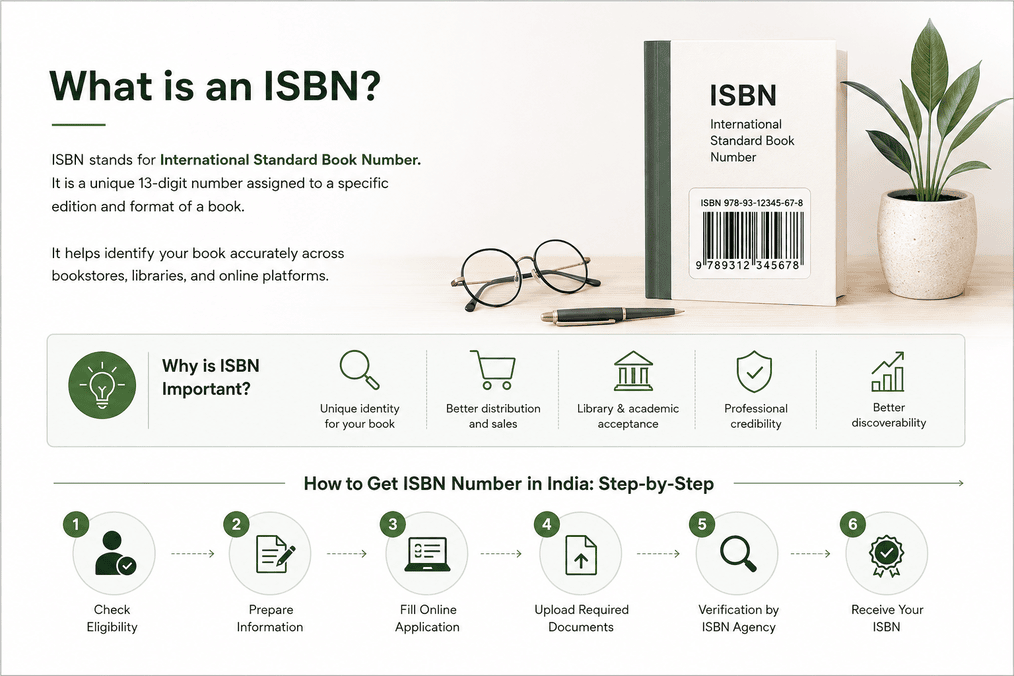
If you’ve ever looked at the back cover of a book, you’ve probably noticed a 13-digit number printed above the barcode. That number is called an ISBN, which stands for International Standard Book Number.
An ISBN is a unique identification number assigned to a specific edition and format of a book. It helps publishers, bookstores, libraries, distributors, and online marketplaces identify one book from millions of others. Instead of relying only on a book’s title or author’s name, the publishing industry uses ISBNs to ensure the correct book is identified, ordered, and catalogued.
Think of an ISBN as your book’s identity card. Just as every individual has a unique identity, every published book has its own ISBN. Even if two books share the same title, their ISBNs will always be different because each number is linked to a specific publication.
What Does ISBN Stand For?
ISBN stands for International Standard Book Number. It is an internationally recognized numbering system used by publishers and booksellers around the world. Although ISBNs are issued by national agencies, they follow a global standard, making it easier to identify books across different countries and distribution channels.
What Does an ISBN Number Look Like in India?
Modern ISBNs contain 13 digits and usually appear in a format like this:
978-93-12345-67-8
Each section of the number has a specific purpose, such as identifying the registration group, publisher, publication, and a final check digit used for validation. Authors don’t need to create this number themselves. Once the ISBN registration process in India is completed successfully, the official ISBN agency assigns a unique ISBN to the book.
Who Needs to Get an ISBN Number in India?
An ISBN is not legally required for every book, but it is strongly recommended if you plan to sell your book through bookstores, online marketplaces, libraries, or educational institutions.
If you’re printing only a few copies for personal use, an ISBN may not be necessary. However, for authors who want to publish professionally and make their books widely available, obtaining an ISBN is an important step before publication.
Before moving ahead, it’s helpful to understand how to get ISBN number in India, especially if you’re planning to publish your first book independently.
Why Is an ISBN Important for Authors?
Many first-time authors wonder whether getting an ISBN is really necessary. After all, you’ve already written your book, invested time in editing, and designed the cover. So, why does one number matter?
The answer is simple—an ISBN helps your book become easier to identify, distribute, and discover. While it doesn’t determine the quality of your book, it plays an important role in making your book part of the professional publishing ecosystem.
Makes Your Book Easy to Identify
Every year, thousands of new books are published, and many have similar titles. An ISBN gives your book a unique identity, ensuring that bookstores, libraries, and online retailers can distinguish it from every other publication.
This reduces confusion and helps readers find the exact edition they’re looking for.
Helps You Sell Through Bookstores and Online Platforms
Most bookstores, online marketplaces, and book distributors use ISBNs to manage their catalogues and inventory.
If you plan to sell your book through platforms like Amazon or make it available in bookstores, having an ISBN makes the listing process smoother and helps retailers identify your book correctly.
Supports Libraries and Academic Institutions
Libraries, universities, and educational institutions rely on ISBNs to catalogue books accurately.
If your book is intended for students, researchers, or educational use, an ISBN improves its chances of being included in library collections and institutional catalogues.
Builds Professional Credibility
An ISBN shows that your book follows internationally accepted publishing standards. While readers may not pay much attention to the number itself, publishers, retailers, distributors, and libraries often do.
Having an ISBN gives your book a more professional identity and prepares it for wider distribution.
Helps Manage Different Editions
If you publish your book in more than one format—such as paperback, hardcover, or eBook—each version should have its own ISBN.
This makes it easier for retailers and distributors to track inventory, manage orders, and ensure readers receive the correct edition.
Is an ISBN Mandatory?
An ISBN is not legally mandatory for publishing a book in India. However, if your goal is to sell your book, reach more readers, or distribute it through professional channels, having an ISBN is strongly recommended.
In short, an ISBN doesn’t make a book successful—but it does make publishing, distribution, and discoverability much easier.
Who Can Apply for an ISBN in India?
One of the biggest misconceptions about ISBN registration is that only publishing companies can apply for it. In reality, the ISBN registration process in India is open to different types of applicants, including individual authors.
Whether you’re an independent author or a publishing house, understanding how to get ISBN number in India will help you complete the registration process with confidence.
Self-Published Authors
If you’re publishing your book independently, you can apply for an ISBN directly. This option is ideal for first-time authors, novelists, poets, professionals, and anyone who want complete control over the publishing process.
Before applying, make sure your book details and supporting documents are ready to avoid delays during verification.
If you’re planning to publish without a traditional publisher, our guide on how to self publish a book in India explains the complete publishing journey, from manuscript preparation to distribution.
Publishing Houses
Publishers regularly apply for ISBNs on behalf of their authors. If you’ve signed a publishing agreement, your publisher will usually handle the ISBN registration process as part of their publishing services.
It’s always a good idea to confirm this before submitting your own application to avoid duplicate requests.
Educational Institutions
Universities, colleges, schools, and research institutions often publish textbooks, journals, conference proceedings, and academic books. These institutions can also apply for ISBNs to ensure their publications are properly identified and catalogued.
Add Your Heading Text Here
Government departments, public sector organizations, NGOs, and research bodies that publish reports, manuals, or educational resources may also be eligible to receive ISBNs for their publications.
Can Multiple Authors Apply Together?
Yes. If a book has two or more authors, only one ISBN is required for that particular edition of the book.
During the application process, the details of all contributing authors can be included. The ISBN identifies the book itself—not the number of people who wrote it.
What If You're Publishing Through a Publisher?
If you’re working with a publishing house, you usually don’t need to apply separately. Most professional publishers manage the ISBN registration process for their authors.
Before applying on your own, check with your publisher to understand who is responsible for obtaining the ISBN. This simple step can save time and prevent unnecessary delays
How to Get ISBN Number in India: Step-by-Step Guide
If you’re wondering how to get ISBN number in India, you’ll be glad to know that the process is straightforward when you have the right information and documents ready.
In India, ISBNs are issued by the Raja Rammohun Roy National Agency for ISBN, which functions under the Ministry of Education. Authors, publishers, educational institutions, and eligible organizations can apply through the official ISBN portal.
Before you begin, make sure your book title, author details, and publication information are finalized. Making major changes after submitting your application may delay the approval process.
Follow these steps to apply for an ISBN in India.
Step 1: How to Get ISBN Number in India - Check Your Eligibility
The first step is to confirm that you’re eligible to apply.
In India, ISBNs are generally issued to:
- Individual authors publishing their own books
- Registered publishing houses
- Educational institutions
- Government organizations
- Research institutions
If you’re publishing through a publisher, ask whether they will apply for the ISBN on your behalf. Most professional publishers include ISBN registration as part of their publishing services.
Knowing who is responsible for the application helps avoid duplicate requests.
Step 2: How to Get ISBN Number in India - Prepare Your Book Information
Before filling out the application form, keep all the necessary details ready.
You’ll typically need information such as:
- Book title
- Author name
- Language of the book
- Book format (Paperback, Hardcover, etc.)
- Publisher details (if applicable)
- Contact information
Take a few minutes to review these details before submitting your application. Small mistakes in the title or author name can lead to unnecessary delays during verification.
Step 3: Complete the Online ISBN Application
Once your information is ready, visit the official ISBN registration portal and fill out the online application form.
Enter every detail carefully and avoid using temporary book titles or incomplete information. If you’re still making major changes to your manuscript or publication details, it’s better to complete those first and then apply.
Submitting accurate information from the beginning makes the review process much smoother.
Step 4: Upload the Required Documents
After completing the application, you’ll need to upload the supporting documents requested by the ISBN agency.
The required documents may vary depending on whether you’re applying as an individual author, publisher, or educational institution.
Before uploading your files, make sure:
- The documents are clear and readable.
- The author name matches your application.
- The book title is consistent across all documents.
- The files follow the format specified on the official portal.
Incomplete or unclear documents are one of the most common reasons applications take longer to process.
Step 5: Wait for Verification
Once your application has been submitted, it moves to the verification stage.
During this process, the ISBN agency reviews your application and supporting documents. If additional information is required, you’ll usually be contacted using the details provided in your application.
Avoid submitting the same application multiple times while it’s under review. Duplicate applications can create confusion and may slow down the process.
After your application is approved, you’ll receive your ISBN.
You can then use this number for the specific edition of your book covered by the application. Keep a record of the assigned ISBN, as you’ll need it while preparing your book for printing, distribution, and online listings.
Remember, if you later publish the same book in a different format or release a revised edition, you’ll generally need a separate ISBN for that version.
Once you’ve received your ISBN, the next step is preparing your manuscript for publication. If you’re unsure what comes after ISBN registration, read our complete guide on the book publishing process to understand editing, formatting, printing, distribution, and book launch.
Documents Required for ISBN Registration in India
If you’re learning how to get ISBN number in India, preparing the required documents in advance can save time and help avoid delays during verification.
The exact documents may vary depending on whether you’re applying as an individual author, a publishing house, or an educational institution. However, keeping the required information ready in advance can make the verification process much smoother.
Documents Required for Individual Authors
If you’re applying as a self-published author, you may be asked to provide:
- A valid government-issued identity proof.
- A completed ISBN application form.
- A copy of your manuscript or the book’s title page, if required.
- Your email address and mobile number for communication.
Before submitting your application, make sure the author name on your documents matches the name mentioned in the application form. Even small spelling differences can delay verification.
Documents Required for Publishers
Publishing houses may need to provide documents that establish their identity as a registered publisher.
These typically include:
- Publisher details or registration information, where applicable.
- Official business address and contact details.
- Information about the book being published.
- Author details related to the publication.
Most established publishers already have a process for handling ISBN applications, making registration straightforward for their authors.
Documents Required for Educational Institutions
Universities, colleges, research institutions, and educational organizations publishing academic books or journals may also be required to submit documents that verify their institutional identity.
These documents help the ISBN agency confirm the applicant before issuing an ISBN.
Tips Before Uploading Your Documents
Before uploading your files, take a few minutes to review everything carefully.
Make sure:
- All documents are clear and easy to read.
- The book title is consistent across every document.
- The author’s name is spelled correctly.
- Your contact information is accurate and up to date.
- The uploaded files follow the format and size requirements mentioned on the official ISBN portal.
A complete and accurate application is much more likely to be processed smoothly than one with missing or incorrect information.
Is ISBN Registration Free in India?
One of the first questions many authors ask before applying for an ISBN is whether they need to pay for it.
The good news is that ISBN registration in India is generally free when you apply through the Raja Rammohun Roy National Agency for ISBN, which operates under the Ministry of Education, Government of India.
The purpose of offering ISBNs free of cost is to encourage publishing and make it easier for authors, publishers, educational institutions, and researchers to publish books that meet international publishing standards.
Why Is ISBN Registration Free?
Unlike some countries where ISBNs are sold by commercial agencies, the Indian government issues ISBNs without charging an application fee to eligible applicants.
This benefits a wide range of people, including:
- First-time authors
- Self-published writers
- Academic researchers
- Educational institutions
- Small publishing houses
By making ISBN registration accessible, the government supports authors who want to publish and distribute their work professionally.
Why Do Some Publishers Charge for an ISBN?
This is where many authors get confused.
If you’re publishing through a self-publishing company or a publishing house, you may notice a charge for ISBN registration as part of a publishing package.
In most cases, you’re not paying for the ISBN itself. Instead, you’re paying for the overall publishing service, which may include manuscript formatting, cover design, editing, printing, project management, and the publisher handling the ISBN application on your behalf.
If you’re unsure, ask your publisher whether the ISBN is being obtained through the official Indian ISBN Agency and whether you’ll be correctly listed as the author or publisher.
Apply Through the Official Portal
If you’re applying for an ISBN on your own, always use the official ISBN registration portal.
Be cautious of third-party websites or individuals claiming to sell government-issued ISBNs or promising guaranteed approvals for an additional fee. Before making any payment or sharing personal information, verify that you’re using the official registration process.
Using the official portal not only saves money but also ensures your application is submitted through the correct government channel.
How Long Does It Take to Get an ISBN in India?
After submitting an application, one of the most common questions authors ask is, “How long will it take to receive my ISBN?”
The answer depends on the verification process. There isn’t a fixed timeline because every application is reviewed individually by the Raja Rammohun Roy National Agency for ISBN. The processing time can vary based on the number of applications received and whether all the required information has been submitted correctly.
If your application is complete and the supporting documents are accurate, the review process is usually smoother. However, missing information or incorrect documents may result in additional verification, which can increase the waiting time.
Can You Get an ISBN Faster?
There is no official fast-track or priority service for ISBN registration in India.
Once you’ve submitted your application, the best approach is to wait for the verification process to be completed. Avoid submitting multiple applications for the same book, as this can create confusion and may delay the review.
If the ISBN agency needs any clarification, they will usually contact you using the details provided in your application.
Plan Ahead Before Publishing
If you’ve already decided on a publication date, don’t wait until the last minute to apply for your ISBN.
Starting the registration process early gives you enough time to complete any formalities before your book goes for printing or is listed on online marketplaces. A little planning now can help you avoid unnecessary stress later.
Common ISBN Registration Mistakes to Avoid in India
Applying for an ISBN is a straightforward process, but small mistakes can lead to unnecessary delays. Here are some common errors first-time authors should avoid.
Applying Before Finalizing Book Details
Before you apply, make sure your book title, author name, and publication details are finalized.
If these details change after your ISBN has been issued, you may have to go through additional formalities depending on the nature of the changes.
Uploading Incorrect or Incomplete Documents
One of the most common reasons applications take longer to process is incomplete documentation.
Before uploading your files, check that they’re clear, readable, and match the information provided in your application.
Using Different Author Names
Your author name should remain consistent across your manuscript, application form, and supporting documents.
Even minor spelling differences can create confusion during verification.
Submitting Multiple Applications
Some applicants think that submitting the same application more than once will speed up the approval process.
In reality, duplicate applications can slow things down and make verification more complicated.
Ignoring the Official Guidelines
Before applying, always read the latest instructions on the official ISBN portal.
Requirements and procedures can change over time, so following the current guidelines helps ensure your application is accurate and complete.
A Simple Tip to Avoid Delays
Most ISBN applications are delayed because of avoidable mistakes rather than complicated procedures.
Review your application carefully, double-check your documents, and submit only when everything is complete. A little attention to detail can make the registration process much smoother.
By now, you should have a clear understanding of how to get ISBN number in India, from checking your eligibility to completing the application and receiving your ISBN. Let’s answer a few common questions authors often have before applying.
ISBN Registration FAQs
Is an ISBN mandatory for publishing a book in India?
No. An ISBN is not legally mandatory for every book published in India. However, if you want to sell your book through bookstores, online marketplaces, libraries, or educational institutions, having an ISBN is strongly recommended. It helps identify your book accurately and supports professional distribution.
Can I apply for an ISBN without a publisher?
Yes. If you’re self-publishing your book, you can apply for an ISBN directly through the official Indian ISBN Agency. Many independent authors choose this option to retain complete control over their publishing journey.
Can I apply for an ISBN before my book is printed?
Yes. In fact, it’s recommended to apply before printing your book. Once your ISBN is issued, it can be included in your book’s barcode, metadata, and publishing details before the final version goes to print.
Do eBooks and printed books need different ISBNs?
Yes. Every format or edition of a book is treated as a separate publication. For example, a paperback, hardcover, and eBook generally require separate ISBNs. This helps retailers and libraries identify each version correctly.
Can I use the same ISBN for multiple books?
No. An ISBN is assigned to one specific title and edition. It cannot be reused for another book, even if it’s written by the same author. Every new publication requires its own unique ISBN.
Where should the ISBN appear on a book?
For printed books, the ISBN is usually displayed on the back cover above the barcode and on the copyright page inside the book. This placement allows bookstores, libraries, and distributors to identify and scan the book easily.
Can I change my book details after receiving an ISBN?
Minor corrections may be possible in some situations, but major changes—such as a new edition, different title, or another format—may require a new ISBN. It’s always best to finalize your book details before submitting your application.
Conclusion
Getting an ISBN is one of the final but most important steps before publishing your book. It gives your book a unique identity and makes it easier for bookstores, libraries, distributors, and online marketplaces to recognize and manage your publication.
If you’re wondering how to get ISBN number in India, the process is much simpler than it appears. Once you prepare the required documents and follow the official application process, obtaining an ISBN becomes a straightforward step toward publishing your book professionally.
Whether you’re publishing your first book or adding another title to your collection, obtaining an ISBN is a small step that supports your book’s professional publishing journey.
If you need guidance with ISBN registration, manuscript preparation, or end-to-end publishing support, AGPH Books is here to help you turn your manuscript into a professionally published book.