
Key Takeaways
- Self-Publish a book in India gives authors greater control over how their book is published and marketed.
- Before publishing, make sure your manuscript is professionally prepared and ready for readers.
- Choosing the right publishing partner can make the publishing journey smoother.
- Decide whether a paperback, eBook, or both formats best suit your audience.
- Understand important publishing requirements such as ISBN, copyright, printing, and distribution.
- Publishing your book is only the beginning consistent marketing helps you reach more readers.
- Compare publishing services based on quality and support, not just price.
Self-publish a book in India has changed the way books are published in India. Today, authors no longer have to wait for approval from a traditional publisher to share their work with readers. Whether you’ve written a novel, a business book, a memoir, or an academic publication, self-publishing gives you the opportunity to publish your book while retaining greater control over the process.
If you’re planning to self-publish a book in India, this guide will help you understand what to expect before, during, and after publication. You’ll learn how self-publishing works, how to choose the right publishing partner, what legal requirements you should know, how to make your book available to readers, and how to promote it effectively. We’ll also discuss the benefits, challenges, estimated costs, and common mistakes to avoid so you can make informed publishing decisions.
Before we begin, it’s important to understand that self-publishing is different from the overall book publishing process. If you’d like to learn about every stage of publishing from planning and writing to editing, printing, and marketing you can also explore our detailed guide on the complete book publishing process.
What Is Self-Publishing?
Self-publishing is a publishing model that allows authors to publish their books independently without signing a traditional publishing contract. Instead of transferring publishing rights to a publisher, authors retain ownership of their work and have greater control over decisions such as pricing, book format, distribution, and marketing.
In recent years, self-publish a book in India has become a preferred choice for many authors because it offers flexibility and a faster route to publication. Writers no longer have to wait months for a manuscript review or publishing approval. Instead, they can choose a publishing partner or platform that aligns with their goals and publish their book once it is ready.
However, self-publishing also comes with responsibilities. As the author, you’ll be involved in important decisions throughout the publishing journey, including selecting the right publishing services, planning your book launch, and promoting your work after publication. Understanding these responsibilities will help you make informed decisions and create a better publishing experience.
Why More Authors in India Are Choosing Self-Publishing
Self-publishing has become an increasingly popular choice among Indian authors. With better access to publishing services, online bookstores, and digital marketing, writers can now publish their books more quickly and connect with readers across the country and around the world.
One of the biggest reasons authors choose self-publishing is the freedom to make their own decisions. They can decide how their book looks, when it will be published, where it will be sold, and how it will be promoted. This level of control is especially valuable for authors who have a clear vision for their work.
Self-publishing also allows authors to retain ownership of their content and, depending on the publishing model they choose, earn a higher share of royalties from book sales. For many writers, this makes self-publishing an attractive option for building a long-term writing career.
In addition, self-publishing has made it easier for professionals such as entrepreneurs, educators, researchers, doctors, and consultants to share their expertise through books. Instead of waiting for a traditional publishing contract, they can publish their work, establish credibility in their field, and reach their target audience more efficiently.
Self-Publishing vs Traditional Publishing
Choosing between self-publishing and traditional publishing is one of the first decisions every author needs to make. Both publishing models have their own advantages, and the right choice depends on your goals, publishing timeline, budget, and the level of creative control you want over your book.
In general, self-publishing gives authors greater control over their work, while traditional publishing involves working with a publishing house that manages many aspects of the publishing process. Each approach offers different opportunities and responsibilities, so it’s important to understand which one best suits your needs.
If you’re unsure which publishing model is right for you, we’ve covered this topic in detail in our guide on Self-Publishing vs Traditional Publishing: Which Is the Better Choice? There, you’ll find a complete comparison of ownership, royalties, creative control, publishing timelines, and other key factors to help you make an informed decision.
Is Self-Publishing Right for You?
Self-publishing isn’t the right choice for every author, but it can be an excellent option if you want greater control over your book and the freedom to make your own publishing decisions. Before choosing a publishing model, think about your goals, budget, timeline, and the kind of support you expect during the publishing journey.
Self-publishing may be the right choice if you:
- Want to publish your book without waiting for approval from a traditional publisher.
- Prefer to retain ownership of your book and publishing rights.
- Want more flexibility in deciding your book’s design, pricing, and publishing schedule.
- Are comfortable taking an active role in promoting your book after publication.
- Want to publish a novel, business book, memoir, academic publication, or self-help book and reach readers directly.
If your priority is creative freedom, faster publication, and greater control over your work, self-publishing is worth considering. However, if you’re looking for a publisher to manage every aspect of the publishing process and are willing to go through a longer selection process, traditional publishing may be a better fit. The right choice ultimately depends on what you want to achieve as an author.
Before You Self-Publish a book in India
Before you publish your book, make sure it is fully prepared for readers. A strong manuscript, professional editing, a well-designed cover, and proper formatting all contribute to the quality of your final book. Rushing through these steps can affect the reading experience and reduce your book’s credibility.
If you’re still working on your manuscript or want to understand each stage in detail, it’s worth learning about the complete book publishing process before moving forward. Having a clear understanding of planning, editing, design, ISBN registration, printing, and distribution will help you make better publishing decisions and avoid common mistakes.
Once your book is ready, the next step is choosing the right publishing partner who can help you publish and distribute your work effectively.
Choose the Right Self-Publishing Partner
While self-publishing gives you greater control over your book, you don’t have to manage every stage on your own. Many authors choose to work with a self-publishing partner to simplify the publishing process and receive professional support where it’s needed.
A self-publishing partner can assist with services such as manuscript review, editing, cover design, book formatting, ISBN assistance, printing, distribution, and marketing. This allows authors to focus on their writing while experienced professionals handle the technical and publishing-related tasks.
For example, publishing service providers such as AGPH Books offer end-to-end support to help authors publish their books professionally. However, every author’s requirements are different, so it’s important to choose a publishing partner that aligns with your goals, budget, and the level of support you need.
If you’re unsure how to evaluate different publishers, read our detailed guide on How to Choose the Best Book Publishing Company in India, where we explain the key factors every author should consider before making a decision.
Understanding ISBN and Copyright for Self-Publishing
When you self-publish a book, two important things to consider are your book’s identification and legal protection. An ISBN helps your book become part of the publishing ecosystem, while copyright protects your original work as an author.
If you plan to sell your book through bookstores, libraries, or online marketplaces, obtaining an ISBN is highly recommended. In India, ISBNs are issued by the Raja Rammohun Roy National Agency for ISBN, under the Ministry of Education, Government of India. Many self-publishing partners also assist authors with the ISBN application process.
Copyright protects your book from unauthorized use or reproduction. Although copyright exists automatically once an original work is created, many authors choose to register it for additional legal protection before publishing.
Before publishing your book, make sure all legal and publishing requirements are complete. Taking care of these details early can help ensure a smoother publishing process.
Publishing Formats: Print, eBook, or Both?
One of the advantages of self-publishing is that you’re not limited to a single book format. Depending on your readers and publishing goals, you can publish your book as a paperback, an eBook, or both.
A paperback is the most popular choice for authors who want to sell through bookstores, participate in book launches, or provide signed copies at events. Many readers also prefer the experience of reading a physical book.
An eBook is ideal if you want to reach readers quickly through digital platforms. It can be purchased and downloaded instantly, making it a convenient option for readers in different cities and countries.
Many self-published authors choose to release both formats. This allows them to reach readers who prefer printed books while also making their work available to those who enjoy reading digitally. The right choice depends on your target audience, budget, and publishing goals.
Print-on-Demand vs Offset Printing
Once you’ve decided to publish a printed book, the next step is choosing a printing method. The two most common options for self-published authors are Print-on-Demand (POD) and Offset Printing. The right choice depends on how many copies you plan to print and how you intend to sell your book.
Print-on-Demand (POD) is a practical option for authors publishing their first book or expecting smaller sales initially. Since books are printed only after an order is placed, you don’t need to invest in a large print run or worry about storing unsold copies.
Offset Printing is better suited for authors who expect higher demand or already have confirmed bulk orders from bookstores, educational institutions, corporate organizations, or events. Although it requires a higher upfront investment, the cost per copy is generally lower when printing in large quantities.
There is no one-size-fits-all solution. If you’re unsure which printing method is right for your book, discuss your publishing goals with your publishing partner. They can help you choose the option that best fits your budget, expected demand, and distribution strategy.
Where Can You Sell Your Self-Published Book?
Publishing your book is only one part of the journey. To reach readers, you also need to decide where your book will be available. One of the biggest advantages of self-publishing is that you have the flexibility to sell your book through multiple channels instead of relying on a single source.
Some of the most common sales channels include:
- Online marketplaces: Platforms like Amazon and Flipkart allow readers to purchase your book from anywhere in India.
- Your own website: Selling directly through your website helps you build your author brand and connect with readers without relying entirely on third-party platforms.
- Bookstores: If your book is distributed through the right channels, it may also be available in selected bookstores.
- Book fairs and literary events: These events provide an opportunity to meet readers, promote your book, and sell signed copies.
- Educational institutions and corporate organizations: Academic books, training manuals, and professional publications can also be sold through universities, schools, libraries, and businesses.
Instead of depending on a single sales channel, many self-published authors use a combination of online and offline platforms to reach a wider audience. Choosing the right mix depends on your target readers and your long-term publishing goals.
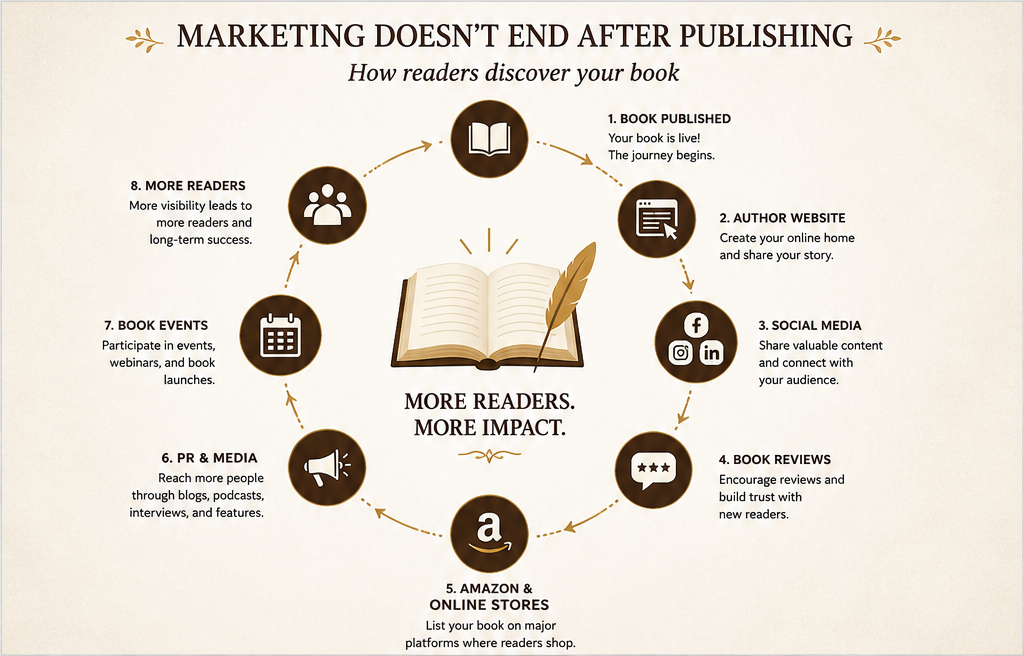
How to Market Your Self-Publish a Book In india
A well-written book doesn’t automatically reach readers. One of the biggest responsibilities of a self-published author is making sure people know the book exists. Marketing should begin before your book is released and continue even after it becomes available.
Start by creating an online presence where readers can learn about you and your work. This could be your own website, an author page, or social media profiles where you regularly share updates, writing insights, and news about your book.
Reader reviews also play an important role in building trust. Encourage early readers to leave honest reviews on platforms where your book is available. Positive reviews help potential buyers make informed decisions and improve your book’s visibility.
You can also introduce your book to a wider audience by writing blog articles, appearing on podcasts, giving interviews, speaking at events, or sharing useful content related to your book’s topic. If your budget allows, digital marketing through search engines and social media can further increase your reach.
Book marketing is an ongoing process, not a one-time campaign. The more consistently you engage with readers and promote your work, the greater the opportunity to build an audience and increase your book’s visibility over time.
Cost of Self-Publish a book in India
The cost of self-publishing a book in India varies from one author to another. It depends on factors such as the type of book, the publishing services required, the printing method, and your marketing plans. Because every book is different, there isn’t a single cost that applies to every project.
Some authors manage tasks like proofreading or formatting on their own, while others prefer to work with a publishing partner who provides complete publishing support. Before making a decision, ask for a clear breakdown of the services included so you know exactly what you’re paying for.
Rather than choosing a publishing package based only on price, focus on the quality of services, transparency, and the support you’ll receive throughout your publishing journey. A well-planned investment can help you publish a professional-quality book and avoid unexpected expenses later.
Advantages of Self-Publish a book in India
The biggest advantage of self-publishing is the freedom to decide how your book reaches readers. Instead of waiting for a publisher to accept your manuscript, you can move forward when your book is ready and choose the publishing approach that works best for you.
Self-publishing also gives authors more involvement in important decisions, such as the book’s design, pricing, publishing timeline, and distribution. Depending on the publishing agreement, you may also retain the rights to your work and have greater flexibility when releasing new editions or future books.
For many professionals, entrepreneurs, educators, and researchers, a book is more than just a publication it’s a way to share knowledge, build credibility, and connect with a wider audience. Self-publishing makes that possible without limiting authors to a single publishing route.
Challenges of Self-Publish a book in India
Self-publishing offers flexibility, but it also comes with responsibility. Unlike traditional publishing, where many publishing decisions are handled by the publisher, self-published authors are more involved throughout the journey.
One of the biggest challenges is making the right decisions at the right time. From choosing a publishing partner to planning your book launch, every step requires careful thought. Authors also need to invest time in promoting their books, building an audience, and staying connected with readers after publication.
For first-time authors, the number of publishing options available today can sometimes feel overwhelming. Taking time to understand the process, asking questions, and working with experienced professionals when needed can make the journey much smoother.
Self-publishing doesn’t mean you have to do everything on your own. It means staying involved and making the right decisions throughout the publishing journey.
Common Mistakes Self-Published Authors Make
Publishing your own book is exciting, but it’s easy to rush the process. Many authors focus on getting their book published as quickly as possible and realize later that a few extra weeks of preparation could have made a big difference.
One mistake is publishing a manuscript before it’s completely ready. Even a good story or valuable idea can lose its impact if the book contains grammar mistakes, formatting issues, or an unprofessional cover.
Another common mistake is choosing a publishing partner without asking enough questions. Before you sign any agreement, understand what services are included, how royalties work, and what kind of support you’ll receive after the book is published.
Many authors also believe that publishing the book is the final step. In reality, that’s when the real work begins. Sharing your book with readers, collecting reviews, and talking about your work regularly are all part of building an audience.
The goal isn’t to publish your book as quickly as possible it’s to publish a book that you’re proud to share with readers. Spending a little more time planning today can save you from disappointment later.
Frequently Asked Questions
1. How do I self-publish a book in India?
To self-publish a book in India, start by completing your manuscript, getting it professionally edited, designing the cover, obtaining an ISBN, choosing a self-publishing partner or platform, and making your book available through online and offline sales channels. A well-planned marketing strategy is equally important after publication.
2. How much does it cost to self-publish a book in India?
The cost depends on the services you choose, such as editing, cover design, formatting, printing, distribution, and marketing. Since every book has different requirements, there isn’t a fixed publishing cost.
3. Is self-publishing better than traditional publishing?
It depends on your goals. Self-publishing offers greater control and flexibility, while traditional publishing provides support through an established publishing house. The right choice depends on your publishing objectives, budget, and timeline.
4. Do I need an ISBN to self-publish a book in India?
Although an ISBN isn’t mandatory for every publication, it is highly recommended if you want to sell your book through bookstores, libraries, and major online marketplaces.
5. Can I earn royalties from a self-published book in India?
Yes. Self-published authors can earn royalties from book sales. The royalty amount depends on the publishing agreement, distribution channels, and the platform or publishing partner you choose.
6. How long does it take to self-publish a book in India?
The publishing timeline varies depending on the manuscript, editing, design, printing, and distribution process. A well-prepared manuscript can usually be published much faster than one that still requires revisions.
7. Can I sell my self-published book on Amazon and other online marketplaces?
Yes. Most self-published books can be distributed through online marketplaces such as Amazon, as well as other sales channels, depending on your publishing partner and distribution plan.
8. Can I self-publish a book without a publisher?
Yes. You can publish your book independently using self-publishing platforms or work with a publishing service provider that assists with editing, design, printing, and distribution while allowing you to remain involved in the publishing process.
Conclusion
Choosing to self-publish a book in India is more than just selecting a publishing method—it’s about taking the next step in your journey as an author. With the right preparation, a clear publishing plan, and the right support, you can turn your manuscript into a professionally published book that reaches readers across India and beyond.
Whether you’re writing your first novel, a business book, an academic publication, or a personal memoir, self-publishing gives you the opportunity to share your ideas on your own terms. Take your time, make informed decisions, and focus on publishing a book that truly represents your work. A well-published book isn’t just something you sell it’s something readers remember.