
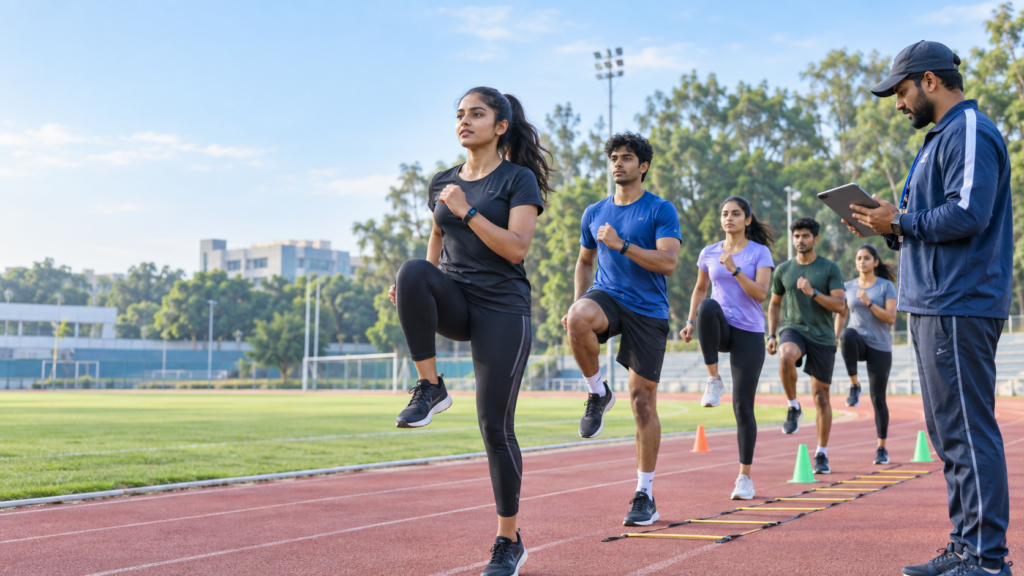
Technology in physical education is changing how students learn movement, fitness and sports skills. Physical education has traditionally depended on observation, demonstration and repeated practice. A teacher watched a student’s movement, a coach used a stopwatch and athletes judged effort largely by feeling. Those methods still matter, but technology now adds something valuable: measurable information.
Wearable devices can record movement and heart rate. Video tools can slow down a skill that happens in a fraction of a second. Mobile applications can organize training plans and maintain progress records. Performance-monitoring systems can help coaches compare the work completed with the body’s response.
The real opportunity is not to make sport more mechanical. It is to use better information to improve teaching, personalize exercise and help people participate safely. Modern Physical Education: Fitness, Technology and Performance by Dr. C. Rama Rao and Dr. Richa Rao explores this relationship between movement science, digital tools and human performance.
Physical education is becoming more individual
Traditional physical-education classes often use the same task and standard for every student. That can create an unfair comparison. A naturally athletic student may complete a run quickly with moderate effort, while another student works close to personal capacity and finishes later.
Technology can shift attention from comparison to personal improvement. When appropriate tools are used, teachers can consider an individual’s effort, progress and technique instead of rewarding speed alone. This supports the broader idea of physical literacy: developing the confidence, competence and motivation to remain active throughout life.
The change matters because the purpose of physical education is larger than producing competitive athletes. It should help students understand their bodies, build sustainable fitness habits and experience movement as something accessible rather than intimidating.
Fitness trackers turn activity into useful feedback
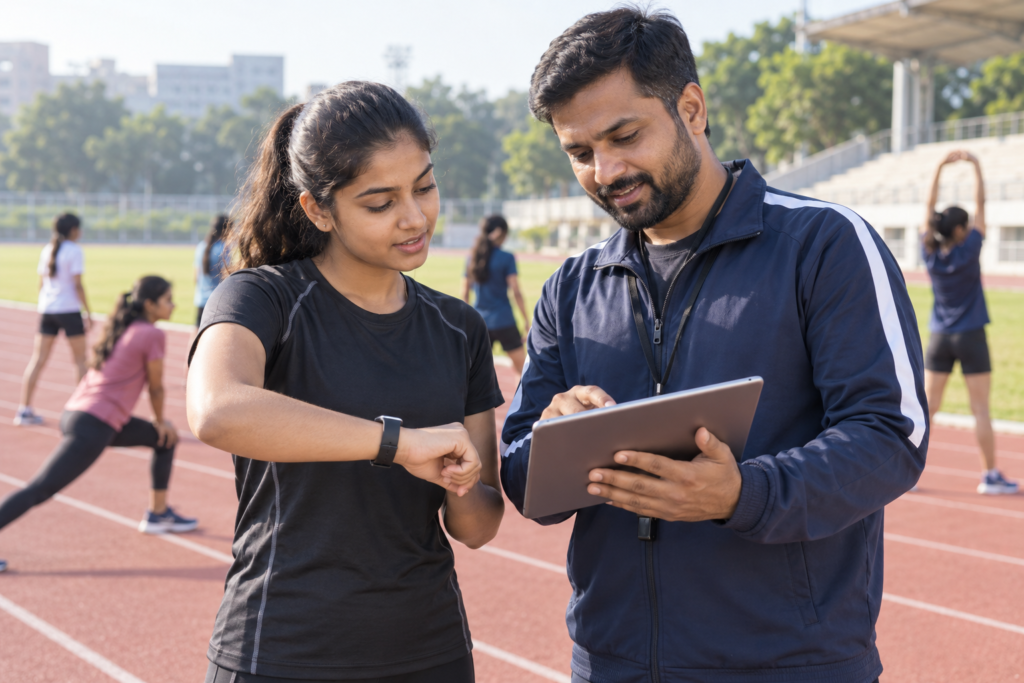
Wearable technology includes smartwatches, activity bands, heart-rate monitors, GPS units and sensor-enabled clothing. These devices collect information about movement or physiological response and convert it into feedback.
Common measurements include:
- steps and general movement;
- exercise duration and distance;
- heart rate during activity;
- speed and changes in direction;
- estimated energy expenditure;
- sleep patterns; and
- recovery-related indicators.
Different sensors serve different purposes. Accelerometers detect motion, GPS records position and distance, and optical sensors estimate heart rate from blood-flow changes. Chest straps measure the heart’s electrical signal and may respond more reliably during vigorous exercise than wrist-based devices.
The educational value comes from interpretation. A step count without context means little. A teacher can use the data to discuss consistency, gradual improvement and the difference between movement volume and exercise quality. Students learn that numbers are tools for reflection, not scores that define their worth.
Digital assessment can reveal progress that the eye misses
Many aspects of fitness were once measured manually: pulse was counted by hand, flexibility was recorded with a box and movement quality was judged visually. Digital assessment can reduce human error and create a more detailed record.
A smartphone can act as a compact assessment tool. Its camera may record a jump, while its motion sensors can help measure movement. Digital inclinometers can assess joint angles. Video software can support technique analysis. Cloud platforms can store repeated assessments and show progress over time.
These tools are particularly useful when improvement is gradual. A student may feel that nothing has changed, yet records may show better consistency, improved range of motion or a healthier response to exercise. Evidence of progress can strengthen motivation.
However, a digital result should never be accepted without judgment. Consumer devices estimate many measurements through algorithms. Accuracy varies by device, placement, movement type and intensity. Technology should support professional observation, not replace it.
Video analysis improves motor learning
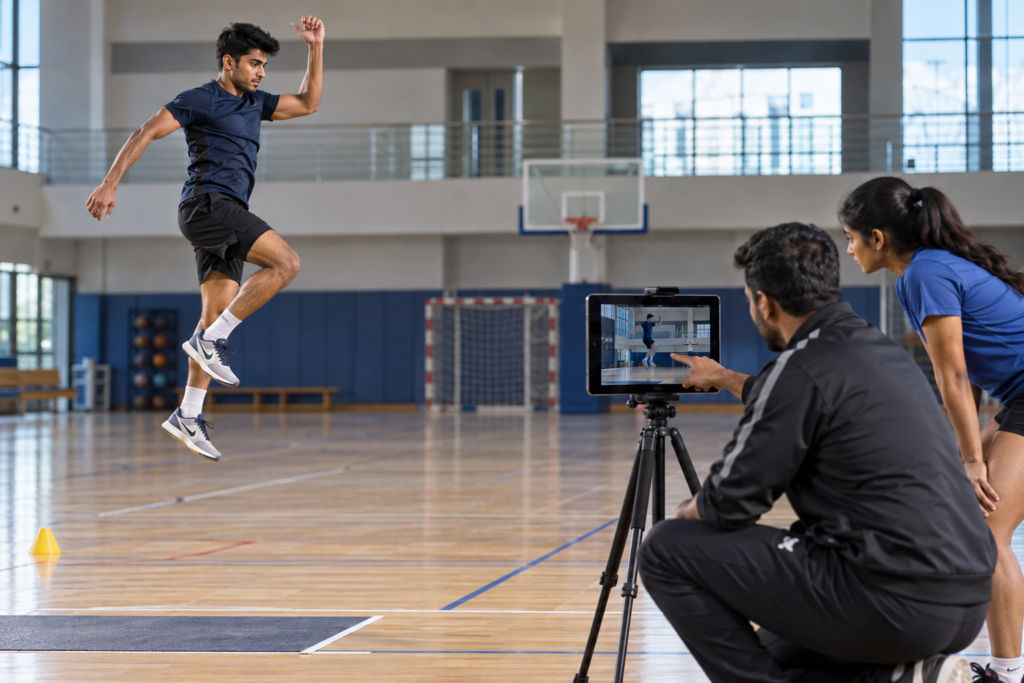
Movement often feels different from how it looks. A student may believe the body is aligned correctly during a squat, throw or jump but cannot see the actual position. Video provides immediate visual feedback.
Slow motion can reveal the timing of a movement. Side-by-side comparison can show changes between two attempts. Drawing tools can highlight joint angles, direction and balance. A teacher can then give one or two specific corrections rather than a long verbal explanation.
Video is most useful when feedback remains focused. Showing a learner ten faults at once can create confusion. A better approach is to identify the change that will produce the greatest improvement, allow another attempt and then review again.
This cycle perform, observe, adjust and repeat—helps students become active participants in learning. They begin to recognize their own movement patterns instead of depending entirely on the teacher.
Mobile applications can extend learning beyond class
Fitness applications can provide demonstrations, reminders, structured routines and progress tracking. They can support students who need to practise outside the scheduled class and help teachers share instructional material in advance.
Used well, an application can:
- demonstrate exercise technique;
- record completed sessions;
- remind users to move during sedentary periods;
- organize individual goals;
- support home-based activity; and
- connect learning in class with daily routines.
Gamification can improve engagement by using challenges, badges or progress levels. Yet motivation should not depend completely on digital rewards. The long-term aim is to help students value movement for health, enjoyment, mastery and social connection.
Performance monitoring helps coaches manage training
In sports training, one workload can produce different effects in different athletes. Performance-monitoring systems bring together information about the work completed and the body’s response.
External-load data describes what the athlete did: distance covered, high-speed efforts, jumps, impacts or weight lifted. Internal-load data describes the biological cost: heart-rate response, perceived exertion, fatigue or recovery indicators.
Looking at both gives the coach a more complete picture. Two athletes may complete the same drill, but one may experience much greater strain. That difference can influence decisions about recovery, training intensity and return from injury.
Data can also support technique and tactical decisions. Position-tracking may show movement patterns during a match. Video can reveal whether fatigue changes form. Repeated testing can help determine whether a training programme is producing the intended adaptation.
The best systems still include conversation. Athletes may feel fatigue, soreness or emotional stress that a device does not capture. Subjective feedback remains important because human performance cannot be reduced to a dashboard.
Technology can make physical education more inclusive
Inclusive practice means adapting activity so that people with different abilities can participate meaningfully. Technology can support this in several ways.
Video demonstrations allow students to learn at their own pace. Individual heart-rate or movement goals reduce direct comparison. Adaptive equipment can improve access for athletes with disabilities. Digital records can help teachers understand progress across a longer period rather than judging a student on one performance.
Technology also supports choice. A student who feels uncomfortable in a competitive team environment may engage through walking, dance, yoga, cycling or a personalized fitness plan. The objective remains movement and development, but the route can differ.
The risks: privacy, pressure and overdependence
Fitness technology introduces ethical responsibilities. Wearables can collect sensitive information about health, sleep, location and behaviour. Schools and sports organizations should be clear about what is collected, why it is needed, who can access it and how long it will be stored.
Students should not be forced to share personal data merely because a device makes collection easy. Parents and learners need understandable information and meaningful choice. Data security is part of student safety.
Constant measurement can also create pressure. Some users become anxious when a daily target is missed or treat an estimate as a medical fact. Others may exercise despite pain because the application has not recognized the problem. Teachers must reinforce that data needs context and that rest is part of training.
There is also a danger of creating inequality. Not every student owns a smartwatch or high-quality phone. A school programme should not disadvantage learners who cannot buy a device. Shared equipment, optional participation and low-cost alternatives can keep technology supportive rather than exclusive.
How schools can introduce technology responsibly
Start with the learning objective
Choose a tool only after deciding what students need to learn. If the goal is to understand pacing, a simple heart-rate monitor may help. If the goal is technique, video may be more useful. Expensive equipment without a clear teaching purpose quickly becomes a distraction.
Teach data literacy
Students should learn where measurements come from, what they can show and where they can be wrong. This turns device use into scientific learning.
Protect privacy from the beginning
Collect the minimum information required. Avoid public rankings based on health data. Use secure systems and explain consent in plain language.
Keep professional judgment in control
A teacher or coach should interpret information alongside observation, communication and knowledge of the individual. Algorithms can support a decision; they should not make it automatically.
Review whether the tool improves participation
Technology is successful when it makes learning clearer, safer or more inclusive. If it increases anxiety, consumes class time or creates barriers, the programme should be adjusted.
The future is informed, not automated
Artificial intelligence, smart clothing, virtual environments and increasingly precise sensors will continue to influence physical education. Their value will depend on how thoughtfully they are used.
The strongest future model combines human coaching with relevant data. Teachers provide empathy, context and motivation. Technology provides information that may otherwise remain invisible. Together, they can help students understand movement more deeply and help athletes train with greater precision.
Physical education should not become a contest between people and machines. It should remain a human discipline strengthened by tools that make progress easier to understand.
Frequently asked questions
What is technology in physical education?
It includes digital tools and devices used to teach movement, assess fitness, provide feedback or monitor training. Examples include wearables, video-analysis software, mobile applications and performance-monitoring systems.
Are fitness trackers accurate?
Accuracy varies. Many devices are useful for observing trends, but estimates such as calories, sleep stages and recovery scores should not be treated as exact clinical measurements.
Can technology replace a physical-education teacher or coach?
No. Technology supplies data and feedback, while professionals provide context, safety, adaptation and human motivation.
How can schools use technology without increasing inequality?
Schools can use shared devices, offer non-digital alternatives, avoid requiring personal equipment and ensure that grades do not depend on purchasing technology.
Further reading
Modern Physical Education: Fitness, Technology and Performance by Dr. C. Rama Rao and Dr. Richa Rao examines fitness, wearables, assessment tools, performance monitoring, training, ethics and inclusive physical education. The book is published by AGPH Books.