
In this article, we will understand educational policy in India, its purpose, historical development, major reforms, National Education Policy 2020, implementation challenges, and the role of different stakeholders.
What Is Educational Policy and Why Does It Matter?
More specifically, educational policy is a set of principles, guidelines, decisions, laws, and standards that help guide how an education system works. It gives governments, institutions, administrators, and educators a framework for planning and managing education.
In simple words, educational policy helps answer important questions such as:
- What should students learn?
- How should education be delivered?
- How can education become more accessible?
- How should teachers and institutions be supported?
- How can educational quality be improved?
Why Is Educational Policy Important?
In practice, educational policy influences many parts of education, including curriculum, teaching methods, assessment, teacher development, resource allocation, and institutional management.
It also focuses on making education more accessible, equitable, accountable, and relevant to changing social and economic needs.
For example, when technology changes the way people learn and work, education policies may need to encourage digital learning and improve technological resources. Similarly, when some communities face limited access to quality education, policies can focus on reducing those gaps.
So, educational policy is not simply a government document. It provides direction for how an education system can respond to the needs of learners and society.
And when that policy is effectively implemented, its impact can reach the classroom, the community, and eventually the wider development of the country.
What Are the Main Purposes of Educational Policy?
First, educational policy gives an education system a clear direction. It helps governments and institutions decide what needs to be improved and how educational goals can be achieved.
1. Why Is Educational Policy Important?
A policy sets broad goals and priorities for education. It creates a common direction for schools, colleges, administrators, and educators and helps maintain consistency across the system.
2. Improving the Quality of Education
Educational policies can establish academic standards, support curriculum development, encourage teacher training, and create systems for monitoring and evaluation. These measures help institutions identify areas that need improvement.
3. Promoting Equal Opportunities
Education should be accessible to learners from different social and economic backgrounds. Policies can help reduce barriers related to income, gender, disability, and geographical location while supporting disadvantaged groups.
4. Responding to Changing Needs
Education must change as society changes. Technology, globalization, workforce requirements, and new learning needs can require educational systems to adapt their curriculum, teaching approaches, and resources.
5. Supporting Social and National Development
Education contributes not only to individual growth but also to social development and national progress. Well-planned policies can support skills, knowledge, inclusion, lifelong learning, and responsible participation in society.
In simple terms, educational policy helps decide where education should go, who it should serve, and how the system can keep improving.
What Are the Main Purposes of Educational Policy?
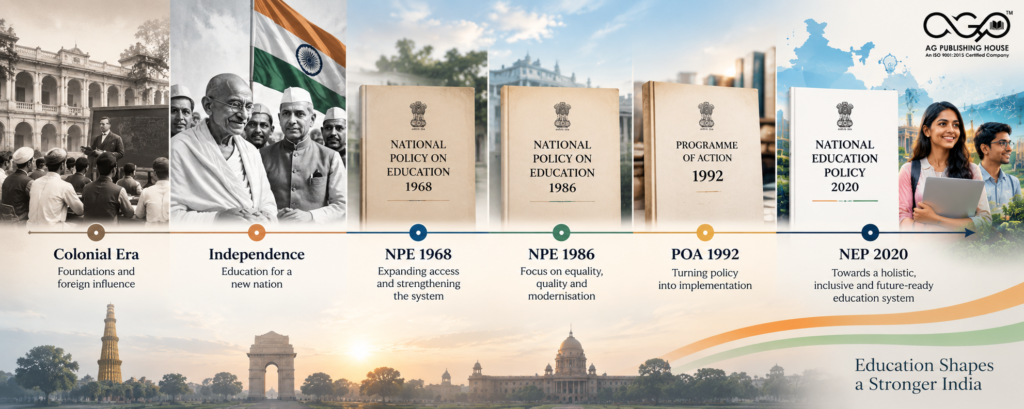
Over time, India’s education system has developed through many stages. Educational policies were influenced by changes in society, politics, the economy, and the needs of the country. During the colonial period, education was largely connected with administrative requirements, while after Independence, the focus increasingly moved toward national development, social justice, access, quality, and inclusion.
Education During the Colonial Period
During this period, the British introduced several educational reforms that helped create formal institutions and administrative structures. However, the book notes that these policies were also shaped by the administrative and economic objectives of colonial rule.
One important milestone was Macaulay’s Minute of 1835, which promoted English as a medium of higher education and increased the spread of Western literature, science, and philosophy.
Another major development was Wood’s Despatch of 1854, which proposed a more organized education system, including expansion at different levels, universities, teacher training, and government-supported schools.
The Hunter Commission of 1882 also focused on primary education and greater involvement of local authorities in educational administration.
Education After Independence
After 1947, education was increasingly viewed as an important instrument for national development and social progress. Various commissions and policies were introduced to expand educational opportunities, improve quality, strengthen teacher education, and promote inclusive learning.
This gradual development created the foundation for the major educational policies and reforms that followed in independent India.
Major Educational Policies in India Since Independence
At first, after Independence, India began building an education system suited to a democratic and developing nation. The focus gradually expanded from simply increasing access to education toward quality, equality, inclusion, skills, and overall development.
National Policy on Education 1968
The National Policy on Education 1968 was the first comprehensive national education policy in India. It focused on national integration, equal educational opportunities, and the three-language formula.
National Policy on Education 1986
The National Policy on Education 1986 placed greater emphasis on universal access and educational equity. It also highlighted women’s education, disadvantaged groups, teacher education, and child-centred learning.
Programme of Action 1992
The Programme of Action 1992 revised and strengthened the implementation of the 1986 policy. It included measures related to educational administration and quality improvement.
National Education Policy 2020
The National Education Policy in India 2020 introduced major changes in the education sector. It emphasizes multidisciplinary learning, flexible curriculum design, skill development, technology integration, and holistic education.
Together, these policy developments show how educational policy in India have evolved with changing national needs. The journey has gradually moved toward making education more accessible, relevant, inclusive, flexible, and prepared for a changing world.
National Educational Policy in India 2020: What Has Changed?
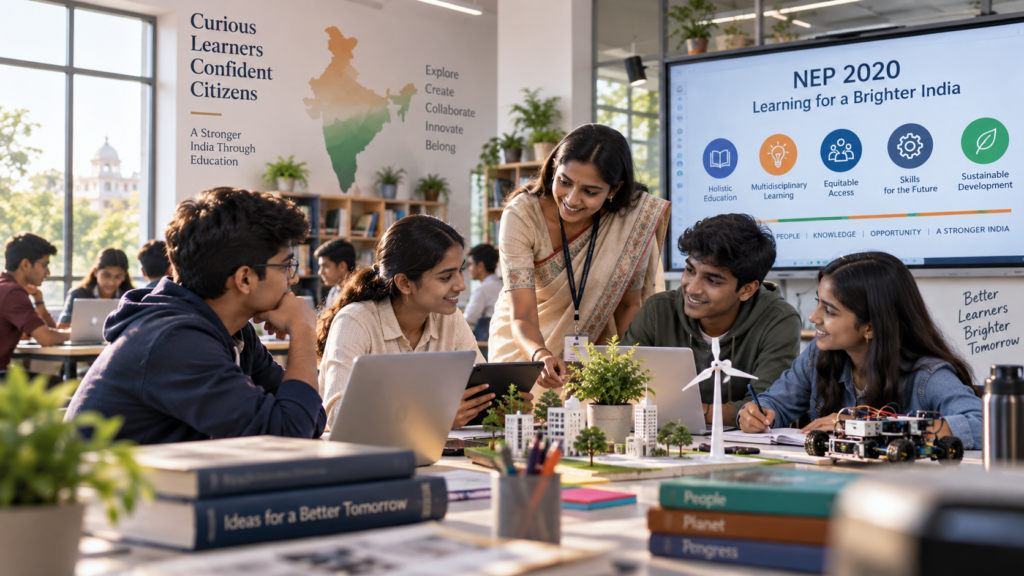
More recently, the National Educational Policy in India 2020 (NEP 2020) represents a major phase in the evolution of educational policy in India. It focuses on making education more flexible, multidisciplinary, skill-oriented, technology-enabled, and centred on the overall development of learners.
1. Focus on Holistic Development
More recently, NEP 2020 gives importance to more than academic knowledge. It promotes the development of creativity, critical thinking, problem-solving abilities, skills, and other aspects of a learner’s overall growth.
2. Flexible and Multidisciplinary Learning
In addition, the policy promotes multidisciplinary education and greater flexibility in curriculum design. This allows learners to explore different areas of knowledge instead of being restricted to narrowly defined learning paths.
3. Greater Importance to Skills
Moreover, modern education needs to prepare learners for changing professional and social environments. NEP 2020 therefore places emphasis on skill development, practical competencies, innovation, and employability.
4. Technology in Education
Similarly, technology has become an important part of contemporary educational reform. NEP 2020 supports the integration of digital technologies to expand access to learning resources and create new opportunities for teaching and learning.
5. Preparing Learners for the Future
The broader aim is to prepare learners for social, economic, and technological changes. The policy connects education with lifelong learning, innovation, research, entrepreneurship, and future readiness.
However, a policy’s objectives alone do not determine its impact. The effectiveness of NEP 2020 and other educational policies depends on how their ideas are translated into planning, resources, institutions, teaching practices, and measurable outcomes. This makes implementation a critical part of education policy analysis.
For a deeper understanding of NEP 2020 and its implications for education, explore this comprehensive guide. Click Here
Published by AGPH Books
From Policy to Practice: How Educational Policy Is Implemented
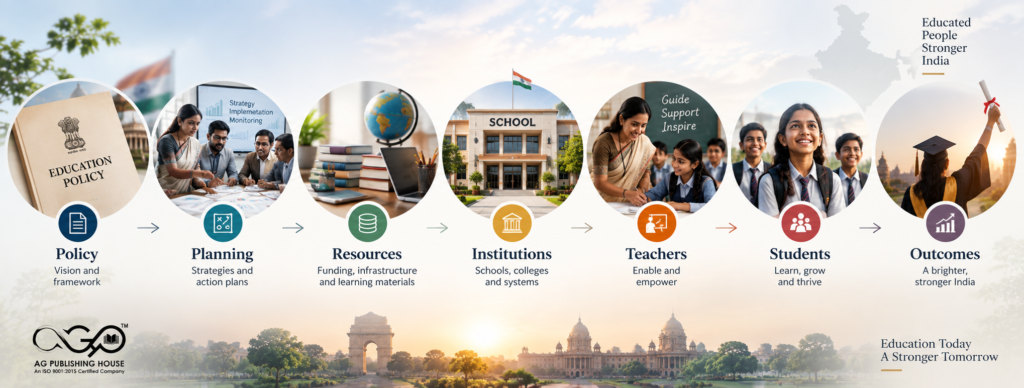
Creating an educational policy is only the first step. Its actual impact depends on how effectively the policy moves from written goals to practical action in schools, colleges, universities, and other educational institutions.
1. Policy Planning
Implementation begins with clear planning. Educational authorities need to define objectives, priorities, responsibilities, timelines, and the resources required to achieve policy goals.
2. Resource Allocation
Policies require adequate financial, human, and material resources. Infrastructure, learning materials, technology, trained teachers, and administrative support are important for turning policy objectives into practical outcomes.
3. Institutional Implementation
Educational institutions play an important role in converting policy directions into everyday practices. Administrators and academic leaders need to coordinate activities, manage resources, and ensure that planned reforms are properly introduced.
4. Teacher Preparation
Teachers are central to education policy implementation because many policy objectives eventually reach learners through classroom teaching. Training, professional development, and adequate support can help teachers understand and apply new approaches.
5. Monitoring and Evaluation
Implementation needs continuous monitoring. Authorities can track progress, identify difficulties, assess outcomes, and make necessary changes. The book describes monitoring, evaluation, and review as important for accountability and continuous improvement.
6. Stakeholder Participation
Educational policy works within a larger system involving governments, institutions, teachers, students, parents, communities, and other organizations. Their participation can provide practical feedback and support implementation.
In simple terms, education policy implementation follows a process: policy goals → planning → resources → institutions → teachers → learners → monitoring → improvement. A strong policy therefore needs not only a clear vision but also practical systems that can carry that vision into action.
Why Is Educational Policy Implementation Difficult?
A well-designed policy does not automatically produce the desired results. The success of educational policy implementation depends on whether the education system has the resources, capacity, coordination, and support required to put the policy into practice.
1. Gap Between Policy and Practice
One of the major challenges is the difference between what a policy proposes and what institutions can actually implement. A policy may have clear objectives, but practical conditions can vary significantly across educational institutions and regions.
2. Limited Resources
Implementation requires adequate funding, infrastructure, teachers, technology, and learning resources. When these are insufficient, institutions may struggle to achieve policy objectives effectively.
3. Teacher Training and Capacity
New policies may introduce changes in curriculum, teaching methods, assessment, or technology. Teachers need appropriate training and professional support to understand and apply these changes in classrooms.
4. Administrative Challenges
Educational policies involve multiple levels of administration. Coordination between government authorities, educational institutions, administrators, and other stakeholders is necessary. Weak coordination can slow implementation.
5. Regional and Social Differences
India has significant differences in educational conditions across regions and communities. Policies therefore need to consider variations in infrastructure, access, economic conditions, and local educational needs.
6. Monitoring and Continuous Improvement
Implementation cannot be treated as a one-time activity. Monitoring, evaluation, and review are needed to identify problems, measure progress, and make suitable modifications. The book emphasizes accountability, evaluation, feasibility, participation, sustainability, and flexibility as important principles of educational policy analysis.
Ultimately, the challenge is to convert policy objectives into real improvements in educational opportunities and outcomes. This requires continuous planning, coordination, participation, and review rather than relying on the policy document alone.
Who Helps Implement Educational Policies?
Educational policy is not implemented by the government alone. It involves several stakeholders in education, and each has a different role in converting policy objectives into practical action.
1. Government and Legislatures
Government authorities are responsible for developing policies, creating legal and administrative frameworks, allocating resources, and establishing systems for implementation and monitoring.
2. Educational Institutions
Schools, colleges, universities, and other institutions translate policy directions into academic and administrative practices. Their leadership and management play an important role in coordinating implementation.
3. Teachers and Educators
Teachers are directly connected with learners. Their teaching practices, professional knowledge, and participation are important when new curricula, teaching methods, technologies, or educational approaches are introduced.
4. Students and Parents
Students are the primary beneficiaries of education policies, while parents can contribute through participation, feedback, and support for learning. Their experiences can also help identify practical issues in implementation.
5. NGOs and Communities
Non-governmental organizations and local communities can support educational initiatives, particularly in areas where additional social or institutional support is required. Community participation can also make policies more responsive to local needs.
6. Coordination Matters
Effective educational policy implementation requires cooperation among these groups. The book highlights participation as an important principle because teachers, students, parents, administrators, and community members can contribute different perspectives to policy development, implementation, and evaluation.
In other words, educational policy becomes meaningful when the different stakeholders involved in education work together to turn policy goals into practical educational experiences.
Local, National and Global Dimensions of Educational Policy
Educational policy in India does not operate in isolation. It is shaped by the needs of local communities, national development priorities, and wider changes taking place around the world.
1. Addressing Local Educational Needs
India has diverse social, economic, cultural, and geographical conditions. Educational policies therefore need to consider differences in access, infrastructure, resources, and the needs of different communities.
The book highlights the importance of participation by local authorities and communities, particularly in the implementation of educational reforms.
2. Supporting National Development
At the national level, education is connected with social justice, economic progress, national integration, and human resource development. Since Independence, educational policies have aimed to expand access, improve quality, reduce disparities, and support national development.
3. Responding to Global Changes
Education is also influenced by developments in technology, research, skills, and changing workforce requirements. Contemporary reforms increasingly focus on technology integration, multidisciplinary learning, innovation, skill development, and preparing learners for a changing world.
This means effective education policy planning needs to balance three things: local realities, national priorities, and changing global needs. A policy becomes more meaningful when these dimensions are considered during its development and implementation.
What Should Future Educational Policies Focus On?
As education continues to change, future educational policies in India will need to respond to new social, technological, and economic realities. The focus should not only be on expanding access but also on making education relevant, inclusive, flexible, and capable of supporting lifelong learning.
1. Technology and Digital Learning
Technology is becoming an important part of teaching and learning. Future policies need to consider how digital tools can expand access to educational resources while supporting effective learning.
2. Skills and Employability
Education needs to prepare learners for changing professional environments. Greater attention to practical skills, vocational learning, innovation, and entrepreneurship can help connect education with future opportunities.
3. Equity and Inclusion
Future policies should continue addressing differences in educational access and opportunities. Supporting disadvantaged groups and reducing barriers related to social, economic, and geographical conditions remain important policy concerns.
4. Lifelong and Flexible Learning
Learning is no longer limited to a particular stage of life. Flexible and multidisciplinary approaches can help learners continue developing knowledge and skills as their personal and professional needs change.
5. Research, Innovation and Future Readiness
The book identifies research, innovation, entrepreneurship, technology integration, skill development, and lifelong learning as important elements of contemporary educational reform.
Ultimately, future education policy in India will need to combine accessibility, quality, equity, flexibility, and adaptability. Its success will depend not only on what policies propose, but also on how effectively those priorities are implemented and reviewed over time.
Frequently Asked Questions About Educational Policy in India
1. What is educational policy?
Educational policy is a framework of principles, guidelines, decisions, laws, and standards that guides the planning, administration, implementation, and development of an education system.
2. Why is educational policy important in India?
Educational policy provides direction for improving access, quality, equity, teacher development, curriculum, resources, and educational administration. It also helps education respond to changing social and economic needs.
3. What is the history of educational policy in India?
The development of educational policy in India has passed through ancient and traditional systems, the colonial period, and post-Independence reforms. After Independence, education increasingly became connected with national development, social justice, access, quality, and inclusion.
4. What were the major educational policies in India after Independence?
Important milestones include the University Education Commission (1948–49), Secondary Education Commission (1952–53), Kothari Commission (1964–66), National Policy on Education 1968, National Policy on Education 1986, Programme of Action 1992, and National Education Policy 2020.
5. What is the National Education Policy 2020?
NEP 2020 is a comprehensive educational reform that focuses on equitable, inclusive, flexible, and high-quality education. It emphasizes holistic development, foundational literacy and numeracy, multidisciplinary learning, skills, technology, research, innovation, and lifelong learning.
6. What are the major challenges in educational policy implementation?
Challenges can include differences between policy objectives and practical implementation, limited resources, infrastructure requirements, teacher preparation, administrative capacity, and regional variations in educational conditions.
7. Who are the major stakeholders in educational policy?
Government authorities, educational institutions, teachers, students, parents, administrators, communities, and other organizations can contribute to policy development, implementation, and evaluation.
8. What is educational policy analysis?
Educational policy analysis is the systematic examination of a policy’s objectives, implementation, resource use, outcomes, relevance, and long-term impact. The book identifies principles such as relevance, effectiveness, equity, efficiency, feasibility, accountability, participation, sustainability, and flexibility.
9. How can educational policies be improved?
Policies can be strengthened through realistic planning, adequate resources, stakeholder participation, effective implementation, monitoring, evaluation, and continuous review. The book particularly emphasizes inclusiveness, equity, accountability, flexibility, and evidence-based decision-making.
10. Why is implementation important in education policy?
A policy creates direction, but implementation determines how its objectives are translated into actual educational practices. Effective implementation connects planning and policy goals with institutions, teachers, learners, resources, and measurable outcomes.
Conclusion
Educational policy plays an important role in shaping the direction of the education system. In India, its development reflects changing priorities related to access, quality, equality, social justice, national development, skills, and technology.
From the policies introduced after Independence to NEP 2020, each stage has attempted to respond to the educational needs of its time. However, the impact of any policy depends greatly on effective planning, adequate resources, capable institutions, stakeholder participation, and continuous monitoring.
Ultimately, educational policy is not only about creating a policy document it is about turning educational goals into meaningful opportunities and outcomes for learners. Understanding this connection between policy and implementation is essential for understanding the development of education in India.