
When we talk about India as a democracy, one document stands at the centre of how the country is governed the Indian Constitution. It explains how the government should function, how powers are divided between institutions, what rights citizens have, and what limits apply to public authority.
But the Constitution is not important only for lawyers, politicians, or students preparing for competitive exams. It is connected to everyday life. Elections, government institutions, Fundamental Rights, Centre State relations and many public decisions work within its framework.
The Constitution also provides a balance between stability and change. It creates rules for governance while allowing constitutional provisions to evolve when society and governance needs change.
So, rather than seeing the Constitution as a difficult collection of legal provisions, it is better to understand it as a framework for how Indian democracy works.
In this guide, we will explore the meaning of the Indian Constitution, its history, major features, Fundamental Rights, government structure, Centre–State relations, elections, constitutional amendments, politics and some of the challenges facing the constitutional system today.
What Is the Indian Constitution?
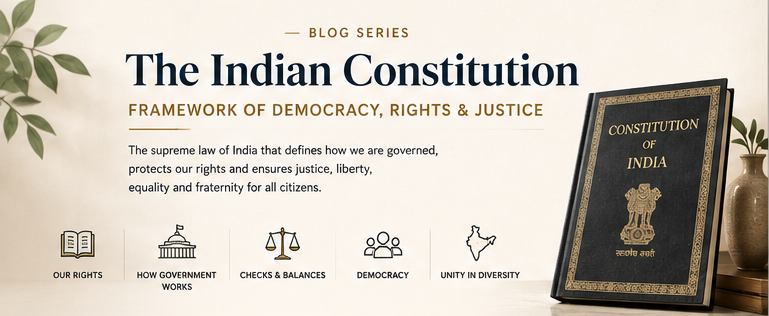
In simple words, the Indian Constitution is the basic framework that explains how India is governed. It defines the structure of government, the powers of different institutions, the rights of citizens and the relationship between the State and its people.
You can think of it as the foundation on which India’s system of government is built.
It helps answer some basic questions: Who makes laws? How is the government formed? What powers does Parliament have? What is the role of the Judiciary? How are powers divided between the Union and States? What rights do citizens have? And how can the Constitution itself be changed?
Constitution Meaning in Simple Words
A constitution is not just a rulebook for government offices. It sets limits on public power and creates a system in which different institutions have defined responsibilities.
This is important because having a government alone does not make a country democratic. There must also be rules explaining how that government can use its authority.
The Indian Constitution provides this framework. Government institutions get their authority through the constitutional system and are expected to function within its limits.
Why Is the Constitution Important?
One of its most important roles is protecting citizens. Fundamental Rights provide constitutional protection related to equality, liberty and dignity, while the Judiciary can examine whether laws or government actions remain within constitutional boundaries.
The Constitution also creates checks and accountability by distributing responsibilities among different institutions. At the same time, it allows change through constitutional amendments.
This balance is important: the Constitution provides stability, but it also has the ability to evolve as society changes.
How Did the Indian Constitution Come Into Being?
The Indian Constitution was not created overnight. It was the result of a long process that included changes in administration during British rule, the freedom movement, growing demands for representation and rights, and detailed discussions about how independent India should be governed.
Constitutional Development Before Independence
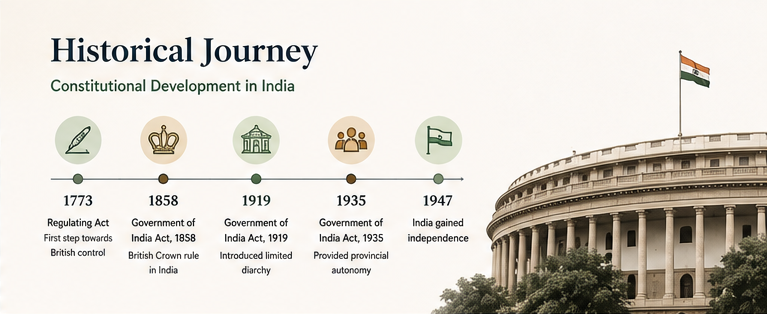
Several laws introduced during British rule gradually shaped India’s administrative and legal institutions.
The Regulating Act of 1773 was an early step towards parliamentary supervision of the East India Company’s administration. It introduced changes such as the Governor General of Bengal and an Executive Council and established the Supreme Court at Calcutta.
Later, the Pitt’s India Act of 1784 increased British government supervision over political and administrative matters. The Charter Acts also brought further changes, including greater administrative centralisation and developments in legislative and executive functions.
These laws did not create India’s present Constitution, but they contributed to the institutional experience that existed before independence.
How the Freedom Movement Shaped Constitutional Ideas
The freedom movement was also a struggle over how India should be governed.
Over time, demands for representation, responsible government, civil liberties and public participation became increasingly important. The idea that Indians should have the authority to frame their own Constitution also gained strength.
This changed the central question from simply improving colonial administration to creating a constitutional system based on the aspirations of the people.
The Constituent Assembly
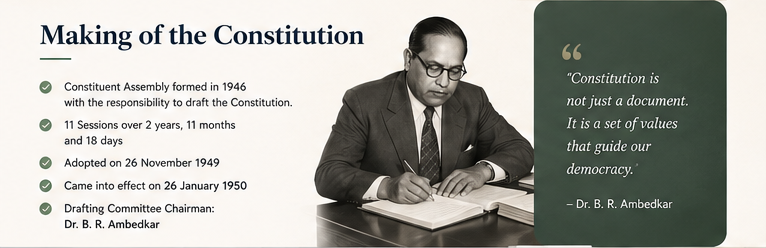
The Constituent Assembly became responsible for preparing the constitutional framework of independent India. It first met on 9 December 1946. Its members came from different regions and professional backgrounds, bringing different perspectives to questions about rights, government powers, federalism and representation.
The Assembly worked through committees, reports, debates and repeated revisions. Members discussed proposals, challenged ideas and suggested changes before reaching agreement.
The important point is that the Indian Constitution was not the work of one person. It emerged from a long process of discussion, disagreement, revision and collective decision-making.
Key Features of the Indian Constitution
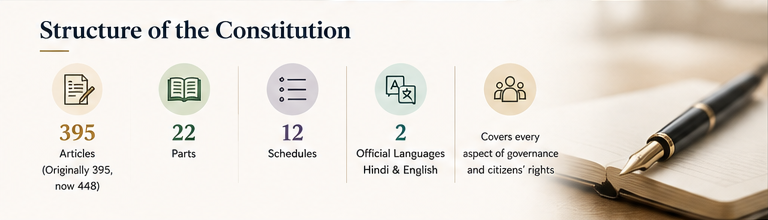
The Indian Constitution is detailed because India is a large and diverse country with different states, languages, communities and regional interests. It therefore does more than establish government institutions. It creates a framework for rights, representation, governance and the distribution of power.
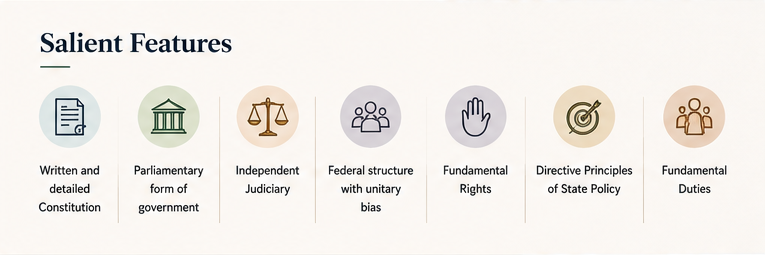
A Written and Detailed Constitution
India has a written Constitution that brings important rules of governance into one constitutional framework.
It deals with subjects such as government institutions, citizenship, Fundamental Rights, Centre–State relations and the functioning of different authorities. This detailed structure helps provide clearer rules for a complex and diverse country.
A Federal Structure With a Strong Centre
India has different levels of government, mainly the Union and State governments. The Constitution distributes responsibilities between them so that both can perform their respective functions.
At the same time, the Union has significant powers in certain areas and circumstances. This structure attempts to balance national unity with the needs and interests of different States.
Parliamentary Form of Government
India follows a parliamentary system in which the government is connected to the elected legislature.
At the Union level, the constitutional structure includes the President, Prime Minister, Council of Ministers and Parliament. The Executive is expected to remain accountable to Parliament, creating a connection between government and elected representatives.
Independent Judiciary
The Judiciary has an important role in interpreting laws and examining whether government actions remain within constitutional boundaries.
The Supreme Court stands at the top of India’s judicial structure, followed by High Courts and other courts. Judicial review provides an important mechanism for examining constitutional questions and protecting constitutional principles.
Fundamental Rights
The Constitution also focuses on protecting individuals. Fundamental Rights are closely connected with values such as equality, liberty and dignity.
They are important because democracy is not simply about electing representatives. It also requires safeguards against unfair treatment and misuse of public power.
Directive Principles and Fundamental Duties
The Constitution also includes Directive Principles of State Policy, which guide the State towards social and economic justice and wider public welfare.
Alongside rights, it recognises Fundamental Duties, reminding citizens that democracy also involves responsibilities towards society and the country.
A Constitution That Can Change
Society keeps changing, so the Constitution needs some ability to adapt. The Indian constitutional system provides an amendment process for making changes when necessary.
However, the Basic Structure Doctrine places limits on this power by protecting essential constitutional principles. This creates a balance between allowing change and preserving the basic identity of the Constitution.
For in depth knowledge of Indian Constitution explore this book: Click here which is published by AGPH Books
Fundamental Rights, Directive Principles and Fundamental Duties
One of the most important parts of the Indian Constitution is the relationship it creates between citizens and the State. It does not only explain how governments should function. It also protects individual rights, sets broader goals for governance and reminds citizens of their responsibilities.
What Are Fundamental Rights?
Fundamental Rights provide important constitutional protections connected with equality, liberty and dignity.
In simple terms, these rights help protect individuals from unfair treatment and unreasonable use of public power. They are also important because citizens have constitutional mechanisms through which rights violations can be challenged in the courts.
This makes Fundamental Rights an important part of democracy. Democracy is not only about electing representatives; it is also about protecting individual freedom and dignity.
What Are Directive Principles of State Policy?
While Fundamental Rights focus strongly on individual protection, the Directive Principles of State Policy take a broader approach.
They provide guidelines for the State, particularly in areas connected with social and economic justice and public welfare. In simple terms, they express goals that governments should work towards for the wider well-being of society.
A simple way to remember the difference is:
Fundamental Rights → Protect important individual freedoms
Directive Principles → Guide the State towards wider welfare
What Are Fundamental Duties?
The Constitution also recognises that citizens have responsibilities.
Fundamental Duties remind citizens that democracy is not only about asking what the government should provide. Citizens also have responsibilities towards society and the country.
Together, these three ideas create a broader constitutional balance:
Rights protect us.
Directive Principles guide the State.
Duties remind citizens of their responsibilities.
Understanding this relationship helps us see that the Indian Constitution is concerned not only with government power, but also with citizens, social welfare and responsible democratic participation.
How Does the Indian Government Work Under the Constitution?
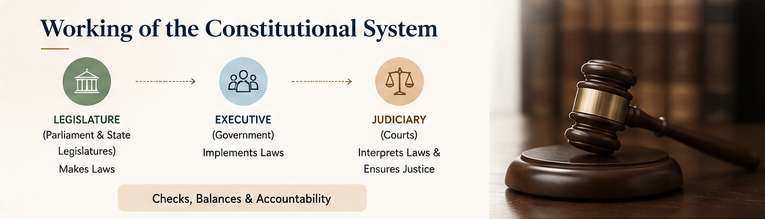
Understanding the Indian Constitution becomes easier when we look at how government actually functions. The Constitution does not place all power in one institution. Instead, different institutions have different responsibilities and work within a system of constitutional checks and accountability.
At the Union level, three major parts are especially important:
Executive → Runs the administration
Legislature → Makes laws and holds the government accountable
Judiciary → Interprets laws and protects constitutional principles
The Executive: Who Runs the Government?
The Executive is responsible for carrying out government decisions and managing administration.
At the Union level, this structure includes the President, Prime Minister and Council of Ministers. The President is the constitutional head, while the Prime Minister and Council of Ministers play the central role in running the government.
In simple terms, Parliament may make a law, but government departments and authorities are responsible for putting that law into practice.
The Prime Minister and Council of Ministers are also connected to Parliament through the principle of accountability and collective responsibility. This keeps the government connected to elected representatives.
Parliament: Where Laws Are Made
Parliament has an important role in making laws, but its work goes beyond legislation.
It provides a platform for debate, representation and examination of government actions. Elected representatives can discuss public issues, debate proposed laws, question the government and examine its policies.
A proposed law also has to follow an established legislative process rather than becoming law simply because it has been suggested.
In basic terms:
Proposal → Discussion → Examination → Parliamentary approval → Constitutional process → Law
The Judiciary: Why Do Courts Matter?
The Judiciary interprets laws, resolves legal disputes and examines whether laws or government actions remain within constitutional limits.
The Supreme Court is at the top of the judicial structure, followed by High Courts and other courts. Judicial review gives courts an important role in protecting constitutional principles.
The three institutions therefore work as part of a connected system. Parliament makes laws, the Executive implements them, and the Judiciary interprets them and examines constitutional questions.
This distribution of responsibilities helps prevent public power from being concentrated entirely in one institution.
Centre - State Relations and Local Government in India
India is a large and diverse country, so governance cannot be handled only by the Union Government. The Indian Constitution therefore provides different levels of government and divides responsibilities between them. This helps balance national interests with regional needs.
How Are Powers Divided Between the Centre and States?
The Constitution divides legislative subjects between the Union and States through the Seventh Schedule. It contains three main lists.
Union List: Covers matters of national importance, such as defence, foreign affairs, currency, banking and railways.
State List: Covers areas mainly connected with regional administration, such as public order, police, agriculture, public health and local government.
Concurrent List: Includes subjects on which both Parliament and State Legislatures can make laws, including areas such as education, forests, criminal law and labour welfare.
This division allows different levels of government to handle matters according to their responsibilities.
Why Do Centre-State Relations Matter?
The relationship between the Union and States is not only about dividing powers. It also requires cooperation and coordination.
Issues such as public health, disaster management, infrastructure and environmental protection may require different levels of government to work together. Financial relations are also important, with mechanisms for sharing revenues and providing financial support between the Union and States.
Why Is Local Government Important?
Governance also needs to reach the local level because many everyday issues—such as roads, sanitation, water supply and local development—are closely connected with communities.
In rural areas, the Panchayati Raj system provides a three-tier structure:
- Gram Panchayat
- Panchayat Samiti
- Zila Parishad
The 73rd Constitutional Amendment gave Panchayati Raj institutions a formal constitutional structure. Their larger purpose is to bring decision-making closer to people and encourage participation in local development.
Together, the Union, State and local levels create a multi-level system of governance, helping India balance national unity, regional diversity and grassroots participation.
Elections and Constitutional Bodies
The Indian Constitution does not deal only with Parliament, the Executive and the Judiciary. It also provides for important institutions that support the functioning of democracy and the relationship between different levels of government. Two important examples are the Election Commission and the Finance Commission.
What Is the Role of the Election Commission?
Elections are one of the most important ways citizens participate in a democracy. Through elections, people choose their representatives and governments are formed.
The Election Commission is connected with managing the electoral process and providing the institutional framework through which voters can participate and representatives can be chosen.
So, elections are not simply about voting on a particular day. They are part of a wider institutional process that supports democratic representation and participation.
What Does the Finance Commission Do?
Government also needs financial resources to function effectively. The Finance Commission plays an important role in the financial relationship between the Union and States.
The Constitution provides mechanisms for sharing and distributing financial resources, including tax devolution and grants. These arrangements help address differences in financial capacity between States and support development.
In simple terms, the Finance Commission helps address an important question:
How should financial resources be shared between the Union and the States?
Together, these institutions show that constitutional governance depends on more than the three major organs of government. Different constitutional bodies support elections, financial federalism and other essential functions of democracy.
Indian Politics and the Constitution
The Indian Constitution provides the basic framework for government, but constitutional institutions do not operate in isolation. Politics, elections, political parties, media and civil society all influence how democracy works in practice.
Political Parties and Democracy
Political parties bring together people with different ideas and interests. During elections, they select candidates, campaign on public issues and seek support from voters.
After an election, the party or group of parties that can form a government takes responsibility for governing. Political parties therefore help connect citizens with government institutions and influence law-making, public policy and political debate.
What Is Coalition Politics?
Sometimes, no single party has enough seats to form a government on its own. In such situations, two or more parties may work together to form a government. This is known as coalition politics.
Coalitions can bring different political interests together, although differences between participating parties can also make decision-making more complicated.
Role of Media and Civil Society
Media helps citizens understand government decisions, political debates and public issues. It can also bring attention to matters that may otherwise receive less public discussion. However, accurate and responsible information is important because misleading information can affect public understanding.
Civil society also contributes to democracy. Organisations and community groups can raise public concerns, encourage participation and engage with public institutions.
In simple terms, the Constitution provides the framework, while political parties, elected representatives, media and civil society operate within and around that framework. Understanding this relationship helps explain how constitutional principles work in real political life.
Contemporary Challenges Facing the Indian Constitutional System

The Indian Constitution was created to provide a stable framework for a changing country. But society does not remain the same. Technology, communication, politics and social expectations continue to evolve, creating new questions for constitutional governance.
Today, some of these questions are connected with privacy, freedom of expression, elections, digital governance, artificial intelligence and cybersecurity.
Privacy and Data Protection
Digital technology has changed how people communicate, shop, work and access government services. At the same time, people share and generate large amounts of personal information online.
This creates an important question: How can individual privacy and data protection be maintained when technology is developing so quickly? The challenge is to ensure that constitutional values remain meaningful in a digital society.
Freedom of Expression in the Digital Age
Social media and digital platforms have made it easier for people to share opinions and information. Public discussion can now happen much faster and reach a much larger audience.
However, this also creates concerns around misinformation, regulation and the limits of online expression. The challenge is finding a reasonable balance between protecting freedom of expression and addressing problems that can arise in digital spaces.
Electoral Reforms and Political Funding
Elections are central to democracy, but electoral systems must also adapt to changing circumstances. Issues such as political funding, voter participation, election technology and campaign regulation continue to be important areas of discussion.
Artificial Intelligence and Cybersecurity
Artificial intelligence is creating new questions about accountability, privacy, decision-making and individual rights. Similarly, greater use of digital systems by governments makes cybersecurity and data protection increasingly important.
The larger challenge is to protect constitutional principles while responding to new realities. This is why understanding the Constitution remains relevant even as technology and society continue to change.
Why Understanding the Indian Constitution Matters Today
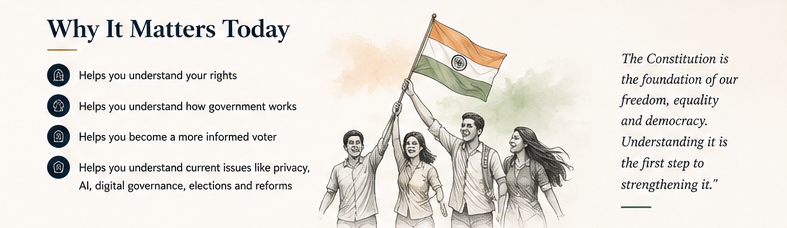
The Indian Constitution may have been created decades ago, but its ideas continue to influence everyday life. We regularly hear terms such as Fundamental Rights, Parliament, federalism, elections, judicial review and constitutional amendments in the news. Understanding their basic meaning makes these discussions much easier to follow.
It Helps You Understand Your Rights
Knowing the Constitution helps citizens understand important protections related to equality, liberty and dignity. You do not need to become a legal expert to benefit from this knowledge. Even a basic understanding can help you make sense of discussions about freedom, privacy and government authority.
It Helps You Understand How Government Works
Once you understand the roles of Parliament, the Executive and the Judiciary, government decisions become easier to follow.
You can understand who makes a law, who implements it, what role courts play and how responsibilities are divided between the Union and States.
It Helps You Become a More Informed Voter
Democracy depends on public participation. Elections give citizens the opportunity to choose representatives, but meaningful participation also requires some understanding of how government and constitutional institutions work.
This knowledge can help people look beyond political slogans and better understand the powers and responsibilities involved in governance.
It also helps citizens understand current debates around privacy, freedom of expression, artificial intelligence, digital governance, elections and political reforms.
Frequently Asked Questions About the Indian Constitution
What is the Indian Constitution?
The Indian Constitution is the fundamental framework that explains how India is governed. It establishes government institutions, distributes powers, protects important rights and provides principles for the functioning of the State.
Why is the Indian Constitution important?
It provides the basic rules for democratic governance, defines the powers and responsibilities of government institutions, protects Fundamental Rights and provides mechanisms for accountability and constitutional review.
What are the main features of the Indian Constitution?
Important features include a written and detailed constitutional framework, parliamentary government, federal arrangements between the Union and States, Fundamental Rights, Directive Principles, Fundamental Duties and an independent Judiciary
What are Fundamental Rights?
Fundamental Rights are constitutional protections connected with values such as equality, liberty and dignity. They provide important safeguards for individuals and can be protected through judicial remedies when violations are alleged.
What are Directive Principles of State Policy?
Directive Principles provide guidelines for the State, particularly in areas related to social and economic justice and public welfare. They express broader goals that governments are expected to work towards.
What is the role of Parliament in India?
Parliament is an important legislative institution. It makes laws, provides a forum for debate and representation, and plays a role in holding the government accountable through parliamentary processes.
What is the Basic Structure Doctrine?
The Basic Structure Doctrine means that Parliament’s power to amend the Constitution is not unlimited. Constitutional amendments cannot be used to destroy its essential foundational principles, including principles associated with democracy, rule of law, federalism and judicial review.
Can the Indian Constitution be amended?
Yes. The Constitution provides procedures for making amendments so that it can respond to changing circumstances. However, the Basic Structure Doctrine places an important limitation on the amendment power.
What is the role of the Judiciary?
The Judiciary interprets laws, resolves legal disputes and has an important constitutional role through judicial review. It can examine whether laws and government actions remain within constitutional limits.
Why are Centre-State relations important?
India has different levels of government, and the Constitution distributes legislative, administrative and financial responsibilities between the Union and States. This helps balance national interests with regional needs.
Why is the Constitution still relevant today?
Society and technology continue to change. Issues such as privacy, digital governance, artificial intelligence, cybersecurity, freedom of expression and electoral reforms create new questions about how constitutional principles should work in changing circumstances.
Conclusion: The Constitution Is More Than a Legal Document
The Indian Constitution is often described as the supreme law of the country, but its importance goes much beyond that. It provides the structure through which India’s democratic system functions. It explains how government institutions are organised, how powers are divided, what rights citizens have and how public authority can be checked.
Its development was shaped by a long history of constitutional changes, the freedom movement and detailed discussions in the Constituent Assembly. Today, it continues to influence elections, government decisions, Fundamental Rights, Centre–State relations and the functioning of courts.
At the same time, India continues to change. Questions around privacy, artificial intelligence, digital governance, cybersecurity and freedom of expression show that constitutional principles remain relevant to new situations.
The best way to understand the Constitution is not simply to memorise its Articles. It is to understand the framework connecting citizens, government, institutions, rights and democracy.
Once that framework becomes clear, many political and constitutional issues that seem complicated become much easier to understand.