
Publishing a book is an exciting journey, but it involves much more than just writing a manuscript. Whether you are a first time author, a researcher, a professor, or a professional looking to share your knowledge, understanding the book publishing process is the key to publishing a high quality book.
From planning your idea and writing your manuscript to editing, designing, getting an ISBN, choosing between self-publishing and traditional publishing, printing, distribution, and marketing, every step plays an important role in your book’s success.
In this complete guide, you’ll learn how to publish a book step by step in simple language. We’ll explain the different publishing models, the role of copyright and ISBN, book marketing strategies, and how academic publishing can support NAAC and API Score requirements. You’ll also discover the different book publishing categories, learn how publishing helps build your authority, and avoid the common mistakes that many first time authors make.
Whether you’re publishing a novel, an academic book, a business guide, or a memoir, this guide will help you understand the entire book publishing process and confidently take your book from an idea to a published reality.
Understanding the Book Publishing Process
If you’ve ever searched for how to publish a book or looked up the steps to publish a book, you’ve probably found that most articles explain only one part of the journey. Some focus on writing, while others talk only about self-publishing or marketing. As a result, many first-time authors don’t get a complete picture of the book publishing process.
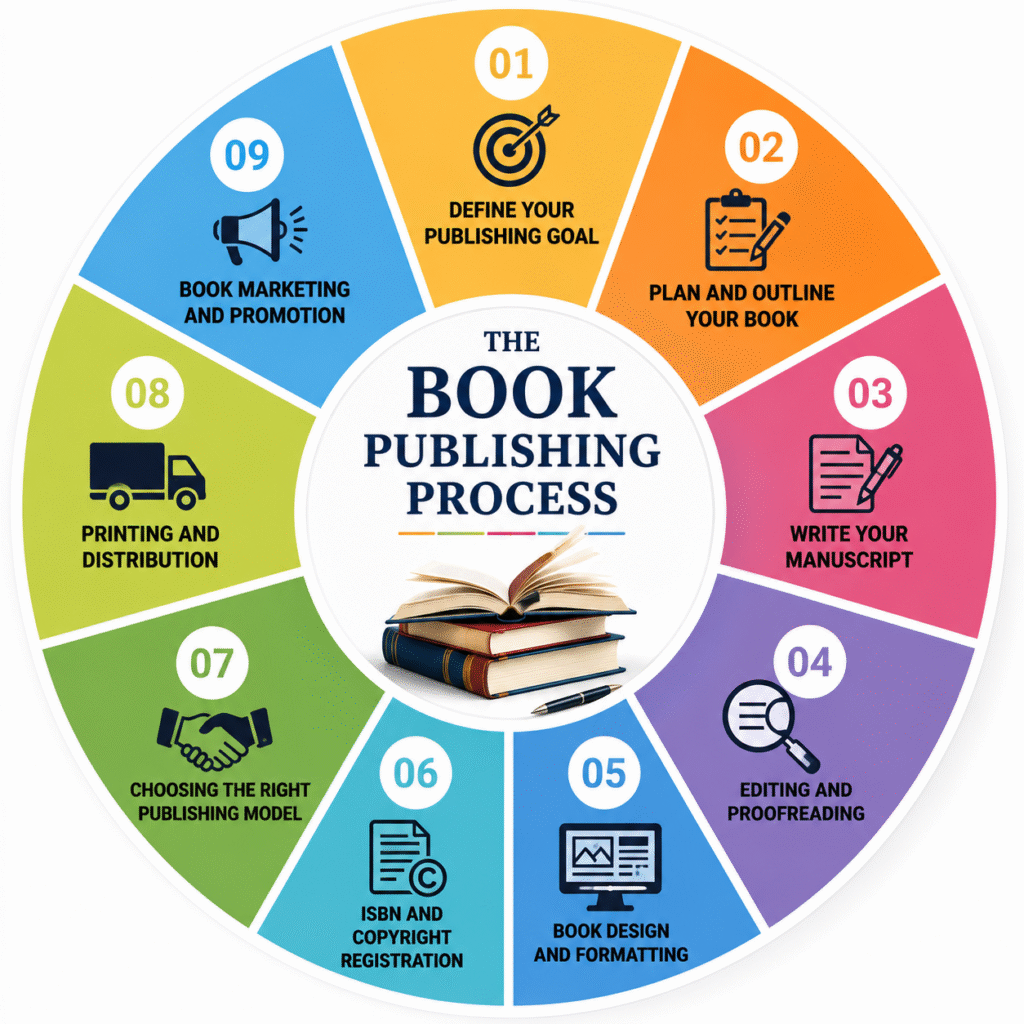
In reality, publishing a book is not a single step. It’s a structured process that begins with an idea and ends with your book reaching readers. Along the way, your manuscript goes through planning, writing, editing, proofreading, book design, ISBN and copyright registration, printing, distribution, and marketing. Each stage builds on the one before it, and skipping any of these steps can affect the quality, credibility, and success of your book.
Whether you choose self-publishing, traditional publishing, or a hybrid model, the overall process remains largely the same. Understanding each stage helps you make informed decisions, avoid common mistakes, and publish a book that you’re proud to share with the world.
Broadly, the book publishing process can be divided into three stages:
- Pre-publishing – planning, writing, and editing the manuscript
- Publishing – design, formatting, legal registration, and choosing a publishing model
- Post-publishing – printing, distribution, marketing, and long-term promotion
1. Define Your Publishing Goal
Before you write your first chapter, be clear about why you want to publish your book. Your goal will influence every decision you make, from choosing a publishing model to setting your budget and planning your marketing strategy.
Common author goals include:
- Building a career as a professional author through ongoing book sales.
- Establishing authority in a professional field, such as consulting, coaching, healthcare, or academia.
- Supporting academic growth, where published books can contribute to career advancement or institutional evaluations.
- Preserving a personal legacy through memoirs, autobiographies, or family histories.
- Growing a business by using a book as a marketing and lead generation tool.
For example, a business book designed to attract clients will have different design, pricing, and distribution requirements than a novel written for bookstore readers. Write your publishing goal in one sentence and keep it in mind throughout the book publishing process. It will help you make better decisions at every stage.
2. Plan and Outline Your Book
A well-planned book is easier to write and edit. Before you start writing, organize your ideas into a clear outline. Divide your book into chapters, list the key points you want to cover, and arrange them in a logical order.
A simple outline helps you stay focused, avoid repeating information, and maintain a smooth flow from one chapter to the next. It also makes the writing process faster because you always know what comes next.
Think of your outline as the roadmap for your book. The stronger your plan, the easier it becomes to complete your manuscript.
3. Write Your Manuscript
Writing your manuscript is where your ideas begin to take shape. While this is often seen as the biggest part of the book publishing process, it’s just one step in the journey. The goal at this stage is to complete your first draft without worrying too much about perfection.
To make the writing process easier:
- Create a writing schedule and stick to it.
- Set a daily word count goal, such as 500 to 1,000 words.
- Finish your first draft before you start editing.
- Keep your outline nearby to stay focused and maintain a logical flow.
The time it takes to complete a manuscript varies from author to author. Some books are finished in a few months, while others take a year or more, depending on the topic, research, and writing schedule.
4. Editing and Proofreading
Completing your first draft is a major milestone, but it’s not the final version of your book. Editing helps improve the quality of your manuscript and ensures readers have a smooth reading experience.
Most books go through four stages of editing:
- Developmental Editing: Reviews the overall structure, content, flow, and organization of the book.
- Line Editing: Improves sentence structure, clarity, tone, and readability.
- Copyediting: Corrects grammar, spelling, punctuation, and consistency.
- Proofreading: The final review to catch any remaining typos or formatting errors before publication.
Many first-time authors skip professional editing to save time or money. However, even experienced writers benefit from a fresh pair of eyes. A well-edited book looks more professional, builds reader trust, and leaves a better impression.
5. Book Design and Formatting
A well-designed book creates a strong first impression and makes reading more enjoyable. This stage includes designing the book cover, formatting the interior pages, selecting readable fonts, setting margins, and organizing chapters in a clean, professional layout.
Your cover is often the first thing readers notice, while proper formatting ensures your book is easy to read in both print and digital formats. Investing in good design not only improves the reading experience but also gives your book a professional look that builds confidence among readers.
6. ISBN and Copyright Registration
Before publishing your book, it’s important to obtain an ISBN and consider copyright registration. An ISBN (International Standard Book Number) is a unique identifier that helps bookstores, libraries, distributors, and online platforms identify your book. In India, ISBNs are issued by the Raja Rammohun Roy National Agency for ISBN under the Ministry of Education.
Copyright protects your original work from unauthorized use. Although copyright exists automatically once an original work is created, registering it provides stronger legal evidence of ownership if a dispute arises.
7. Choosing the Right Publishing Model
Choosing the right publishing model is one of the most important decisions in the book publishing process. The best option depends on your publishing goals, budget, timeline, and how much control you want over your book.
There are three main publishing models:
- Traditional Publishing: A publishing house manages editing, design, printing, distribution, and marketing. In return, the publisher usually retains certain publishing rights and shares royalties with the author.
- Self-Publishing: Authors manage the publishing process themselves or work with service providers. This option gives you complete creative control, faster publishing, and a higher share of royalties.
- Hybrid Publishing: This model combines elements of traditional and self-publishing. Authors pay for selected publishing services while still receiving professional support and retaining more control over their work.
There is no single “best” publishing model. Choose the one that matches your publishing goals and long-term plans. Before signing any agreement, always review the publishing terms, royalty structure, rights, and services included.
8. Printing and Distribution
After your book is ready for publication, the next step is printing and distribution. The printing method you choose will depend on your budget, expected demand, and sales strategy.
You generally have two options:
- Print-on-Demand (POD): Books are printed only when an order is placed. This reduces upfront costs and eliminates the need to store unsold copies.
- Offset Printing: Best suited for large print runs, as it lowers the cost per copy. However, it requires a higher initial investment and storage space.
Once printed, your book should be distributed through channels where readers can easily find and purchase it. These may include online marketplaces like Amazon and Flipkart, bookstores, libraries, or your own website.
Many authors use a combination of print-on-demand for online orders and offset printing for bulk orders, book launches, or events. Choosing the right printing and distribution strategy helps your book reach a wider audience.
9. Book Marketing and Promotion
Publishing your book is only the beginning. To reach the right readers, you need a strong marketing strategy. Even a well written book may go unnoticed if people don’t know it exists.
Some of the most effective ways to promote your book include:
- Creating an author website or landing page
- Promoting your book on social media
- Listing your book on online marketplaces
- Collecting reader reviews and ratings
- Running online advertising campaigns
- Participating in book launches, podcasts, interviews, or literary events
- Building an email list to stay connected with readers
Book marketing is an ongoing process, not a one-time activity. Consistent promotion helps increase your book’s visibility, attract more readers, and improve long-term sales.
Academic Publishing, NAAC, and API Score
For academicians and researchers, publishing a book can support both professional growth and research visibility. In many higher education institutions, books and book chapters published by recognized publishers are considered during academic evaluations, subject to the applicable university and regulatory guidelines.
The National Assessment and Accreditation Council (NAAC) assesses the overall quality and performance of higher education institutions in India. Faculty publications, including books, book chapters, and research contributions, can strengthen an institution’s academic profile as part of the accreditation process.
Similarly, many universities consider publications while evaluating faculty members for career advancement under their academic performance or promotion frameworks, in accordance with the applicable UGC regulations and institutional policies.
If you’re publishing an academic book, choose a reputable publisher, obtain a valid ISBN, maintain proper publication records, and ensure your work meets your institution’s requirements. Taking these steps can improve the academic value and recognition of your publication.
Building Authority Through Book Publishing
Publishing a book is more than sharing your ideas. It helps establish your credibility and showcase your expertise. A well written book can build trust with readers, clients, employers, and industry professionals, making it easier for people to recognize your knowledge.
For example, a business consultant can use a book to demonstrate industry expertise and attract new clients. A doctor may publish a book to educate patients and build public trust. An educator or researcher can strengthen their academic profile by sharing research and subject knowledge. Similarly, an entrepreneur can use a book to tell their business journey, share insights, and build a stronger personal brand.
A published book can also create opportunities such as speaking engagements, media interviews, collaborations, and professional networking. While a book alone doesn’t make someone an authority, consistently sharing valuable and well-researched content can help build a strong and lasting reputation.
Book Publishing Categories
Book publishing includes a variety of categories, each created for a different purpose and audience. Choosing the right category is important because it influences your writing style, book design, marketing strategy, and the readers you want to reach.
Fiction
Fiction books are based on imagination and storytelling. They include genres such as romance, mystery, fantasy, thriller, and historical fiction. These books are written to entertain, inspire, and connect with readers through compelling stories.
Examples: The Guide by R. K. Narayan, Train to Pakistan by Khushwant Singh, Harry Potter by J.K. Rowling
Non-Fiction
Non-fiction books are based on real-life experiences, facts, or expert knowledge. They include biographies, memoirs, self-help, business, health, education, history, and personal development. Their purpose is to inform, educate, or inspire readers.
Examples: Wings of Fire by A. P. J. Abdul Kalam and Atomic Habits by James Clear
Ghostwriting
Ghostwriting is a publishing service where a professional writer creates a book on behalf of someone else. The book is published under the client’s name, while the ghostwriter usually remains anonymous. This service is commonly used by entrepreneurs, business leaders, public speakers, doctors, and public figures who have valuable ideas but need help turning them into a book.
Example: Many autobiographies, leadership books, and business books by well-known personalities are developed with the support of ghostwriters or editorial collaborators, although the writer’s name is often not disclosed due to confidentiality agreements.
Common Mistakes First Time Authors Should Avoid
Publishing your first book can be exciting, but small mistakes can affect its quality and success. Being aware of these common mistakes can save you time, money, and unnecessary revisions.
- Skipping the planning stage: Writing without a clear outline often leads to an unorganized manuscript.
- Ignoring professional editing: Grammar mistakes, weak structure, and inconsistencies can reduce the credibility of your book.
- Choosing the wrong publishing model: Select a publishing option that matches your goals, budget, and expectations.
- Overlooking book design: A poor cover or poorly formatted interior can discourage readers from buying your book.
- Not obtaining an ISBN: A valid ISBN is important for professional distribution and discoverability.
- Ignoring book marketing: Publishing your book is only the beginning. Without promotion, it can be difficult to reach your target audience.
- Rushing the publishing process: Take time to review every stage before publishing. A well-prepared book creates a better reading experience and leaves a lasting impression.
Avoiding these mistakes will help you navigate the book publishing process more confidently and improve your chances of publishing a successful book.
Conclusion
Publishing a book is a journey that requires careful planning, creativity, and the right guidance. By understanding each stage of the book publishing process from setting your publishing goal and writing your manuscript to editing, designing, obtaining an ISBN, choosing a publishing model, printing, distribution, and marketing you can make informed decisions and avoid common mistakes that often slow down first-time authors.
Every successful book starts with a strong idea, but its success depends on how well that idea is developed and presented to readers. Whether you’re publishing a novel, an academic book, a business guide, or a memoir, following a structured publishing process will help you create a professional-quality book that reaches the right audience and leaves a lasting impression.