
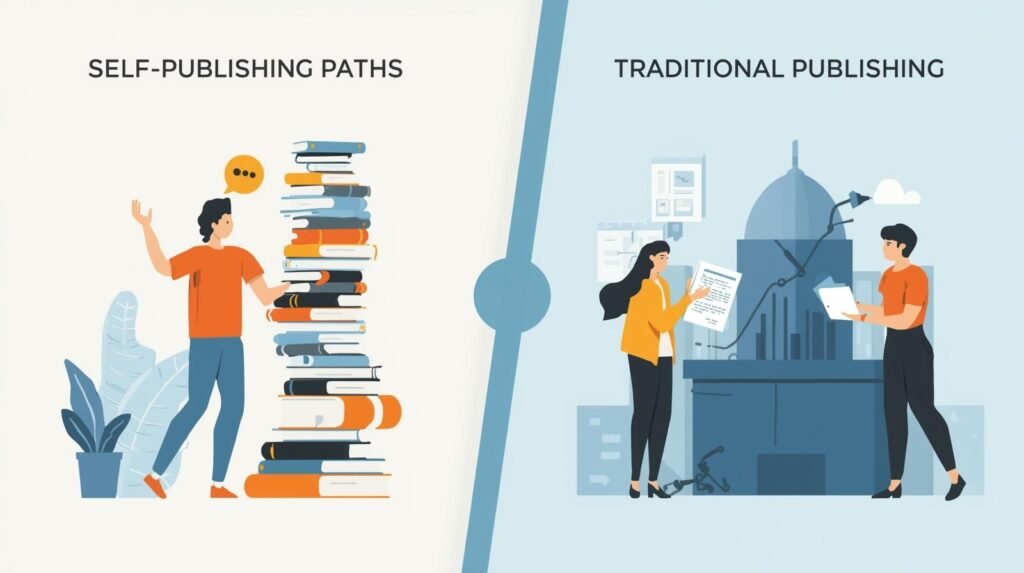
Publishing a book in 2025 is easier than ever, but choosing self-publishing or traditional publishing still feels confusing for new authors. Each option has its own benefits, challenges, timelines, and earning potential.
In this guide, you’ll learn the key differences, costs, control, royalties, distribution reach, and which publishing path is the better choice for your writing goals. By the end, you’ll be able to confidently decide whether self-publishing or traditional publishing works best for you.
Table of Contents
Self-Publishing in 2025
Self-publishing continues to rise in popularity thanks to platforms like Amazon KDP, Notion Press, and IngramSpark. Moreover, these tools have made it easier than ever for authors to publish their work without depending on traditional gatekeepers. In 2025, self-publishing is not just a backup option—it has become a powerful and respected path for writers who want more control over their creative and financial journey. Additionally, whether you’re writing a novel, a self-help book, poetry, or even a children’s book, self-publishing gives you full authority over how your book looks, how much it costs, and where it reaches readers. Furthermore, unlike traditional publishing, where authors often wait months for responses, self-publishing allows you to move at your own pace. As a result, you decide when your book is ready and how it should be presented to your audience. Therefore, with digital distribution growing globally, self-published books can now reach readers across multiple countries within hours of release. Ultimately, this level of independence and speed is one of the biggest reasons self-publishing continues to expand.
What Self-Publishing Means
Self-publishing means you are in charge of the entire publishing process. In other words, you don’t need approval from a publishing house; instead, you manage the essential steps like editing, cover design, book formatting, ISBN setup, and marketing. Although this might sound like a lot, it also gives you complete creative freedom. You choose your own cover, decide your book’s pricing, and maintain full ownership of your work. Most importantly, you keep a much higher share of royalties—often up to 70%—which makes self-publishing a financially rewarding option for many authors. Additionally, self-publishing allows you to publish on your own timeline, experiment with different editions or formats, track real-time sales, and reach global readers instantly through platforms like Amazon KDP and IngramSpark. Consequently, this flexibility makes it an empowering path for both new and experienced writers who want transparency, independence, and long-term control over their creative journey.

Traditional Publishing in 2025
Traditional publishing remains appealing for writers who want professional support, credibility, and bookstore presence. In this model, your manuscript is reviewed and selected by a publishing house, which then manages editing, cover design, printing, marketing, and distribution. However, the process is highly competitive and often requires a literary agent to pitch your work, negotiate contracts, and guide you through industry expectations. While traditional publishing offers strong credibility, expert editorial help, established marketing channels, and guaranteed placement in bookstores without any upfront cost, it also comes with limitations. For example, the timeline is slow—often 6 to 18 months—royalties are lower (around 5–12%), and authors may have reduced creative control, as publishers typically decide the final title, cover design, formatting, and even pricing. Furthermore, authors are often expected to participate in their own marketing efforts despite being traditionally published. Nevertheless, many writers choose this path for the prestige, industry connections, and long-term career opportunities it can provide.
Key Differences Between Self-Publishing and Traditional Publishing

| Category | Self-Publishing | Traditional Publishing |
|---|---|---|
| Creative Control | Full control over cover, content, pricing, and formatting | Publisher makes most creative decisions, including title and cover |
| Timeline | Fast publish in days or weeks | Slow typically 6 to 18 months before release |
| Rights & Ownership | Author retains all rights and full ownership | Publisher may acquire certain rights during the contract period |
| Royalty Rates | High royalties (up to 70%) | Lower royalties (around 5–12%) |
| Upfront Costs | Author pays for editing, design, marketing, etc. | No upfront costs; publisher invests |
| Marketing Responsibility | Author handles all marketing efforts | Publisher provides limited marketing; author still promotes actively |
| Distribution | Mostly online platforms like Amazon KDP, IngramSpark | Strong print distribution, bookstores, libraries |
| Flexibility | High can update book anytime | Low changes require publisher approval |
Which Option Is Better for New Authors in 2025?
The best choice depends on your goals as an author.
When Self-Publishing Makes Sense
It’s ideal if you want faster results, complete control, and higher royalties. It also works well for authors comfortable managing their book’s marketing and production.
When Traditional Publishing Is Better
This path suits authors who want strong print presence, established industry backing, and added credibility—especially in genres like non-fiction, academic writing, or literary fiction.
Conclusion
In 2025, both self-publishing and traditional publishing continue to offer meaningful advantages for authors. On one hand, self-publishing stands out for its speed, flexibility, and independence, giving you full control over your book’s creative direction, pricing, design, and release schedule. On the other hand, the earning potential is also higher, as you keep a larger share of the royalties. Therefore, it is ideal for authors who want to build a long-term writing career, explore multiple genres, or publish several books each year without waiting for approval.
Traditional publishing, however, remains a respected path known for its credibility, professional editing, established bookstore distribution, and industry recognition. Even so, it is often the better option for authors who prefer a hands-off approach or those seeking wider media exposure. Ultimately, the right choice depends on your goals, budget, and desired level of creative control. In the end, whichever route you choose, today’s publishing landscape gives you more opportunities than ever to share your story with the world.
Ready to publish your book?
Discover AGPH Books’ expert publishing services and take the next step toward becoming a published author.
FAQs
Yes, unless you invest in editing or design. Traditional publishers cover those costs but give lower royalties.
Self-publishing is much faster—days instead of months.
Yes, especially if your book performs well.
Self-publishing usually offers higher income due to 70% royalties.
Yes, especially for print sales, bookstores, and media visibility.