

Every book begins with an idea, but not every author has the time, writing experience, or confidence to turn that idea into a finished manuscript. That’s where ghost book writing comes in.
Many people assume that only celebrities or public figures use ghostwriters. In reality, ghost book writing has become a popular choice for entrepreneurs, business leaders, professors, doctors, researchers, coaches, and professionals who have valuable knowledge to share but need help putting it into words.
Hiring a ghostwriter doesn’t mean the story isn’t yours. Your ideas, experiences, expertise, and vision remain at the heart of the book. A ghostwriter simply helps organize those thoughts into a clear, engaging manuscript while matching your voice and style.
Whether you’re planning to write a business book, a memoir, an academic publication, or a non-fiction guide, understanding how ghost book writing works can help you decide if it’s the right approach for your project.
In this guide, you’ll learn what ghost book writing is, how the process works, who should consider hiring a ghostwriter, what to expect during the collaboration, and the important factors to keep in mind before getting started.
Key Takeaways
- Ghost book writing transforms your ideas into a professionally written manuscript.
- You retain ownership of your book while collaborating with an experienced writer.
- It’s an ideal solution for busy professionals, entrepreneurs, educators, and first-time authors.
- A successful project depends on clear communication, mutual trust, and regular feedback.
- The right ghostwriter captures your voice not replaces it.
- Always choose quality, experience, and transparency over the lowest price.
What Is Ghost Book Writing?
At its core, ghost book writing is a professional writing service where an experienced writer helps turn someone else’s ideas, knowledge, or life experiences into a complete book. The finished manuscript is created through collaboration, but it is published under the author’s name, not the ghostwriter’s.
Think of it this way: you bring the expertise, stories, and vision, while the ghostwriter brings the writing skills needed to shape those ideas into a book that readers can enjoy and understand.
Ghost book writing is common across many genres. Business leaders use it to share industry insights, entrepreneurs write books to strengthen their personal brand, doctors publish healthcare guides, professors document years of research, and individuals tell their life stories through memoirs. In each case, the ideas belong to the author, while the ghostwriter helps communicate them effectively.
One of the biggest misconceptions about ghostwriting is that someone else creates the entire book without the author’s involvement. In reality, a good ghostwriter spends considerable time understanding the author’s voice, experiences, opinions, and goals. The writing process usually includes interviews, discussions, research, and multiple rounds of feedback to ensure the final manuscript feels authentic.
For example, imagine a successful entrepreneur who has spent twenty years building a business. They have valuable lessons to share but struggle to find the time to write. Instead of postponing the project for years, they work with a ghostwriter who interviews them, organizes their ideas, and develops a well-structured manuscript. The knowledge is still the entrepreneur’s-the ghostwriter simply helps present it in a way that is engaging and easy to read.
Another example is a professor who wants to publish a book based on years of teaching and research. While they understand the subject deeply, writing for a broader audience can be challenging. A ghostwriter can help simplify complex ideas without changing the author’s original message.
It’s also important to understand that ghost book writing is different from editing or proofreading. An editor improves an existing manuscript, while a ghostwriter helps create the manuscript itself. If you already have a completed draft, you may only need editing. If you have ideas but no manuscript, ghost book writing could be the better option.
Most ghostwriting projects are guided by a written agreement that clearly outlines confidentiality, ownership, revisions, timelines, and payment terms. In many cases, the author retains full rights to the completed manuscript, while the ghostwriter agrees not to claim public authorship unless both parties decide otherwise.
Ultimately, ghost book writing is not about replacing the author’s voice. It’s about helping that voice reach readers in a clear, compelling, and professional way. For many busy professionals and first-time authors, it offers a practical path to turning years of experience into a book that can educate, inspire, or leave a lasting legacy.
Why Authors Choose Ghost Book Writing
Writing a book sounds exciting until you actually sit down to do it.
Many people begin with enthusiasm. They have a notebook full of ideas, a folder of research, or years of experience they want to share. But after writing a few pages, reality sets in. Work gets busy, family responsibilities take over, and the manuscript slowly moves to the bottom of the priority list.
This is exactly why many authors choose ghost book writing.
It’s not because they don’t have ideas. It’s because turning those ideas into a complete book requires time, structure, and consistent effort. A ghostwriter helps bridge that gap.
Busy Professionals Don't Always Have Time to Write
Imagine you’re a business owner who spends ten hours a day managing clients, employees, and meetings. You know your industry inside out and have countless lessons that could help others. Yet every time you plan to work on your book, something more urgent comes up.
Months turn into years, and the manuscript never moves beyond a rough outline.
This situation is more common than people think.
Ghost book writing allows professionals to continue doing what they do best while gradually building a book through regular conversations and planned writing sessions.
Having Knowledge Doesn't Always Mean You Enjoy Writing
Being an expert and being a writer are two completely different skills.
A doctor may explain medical conditions brilliantly to patients but struggle to write a chapter that keeps readers engaged. A professor might have decades of research but find it difficult to simplify technical concepts for a wider audience.
That doesn’t make them any less knowledgeable.
It simply means they need someone who can translate their expertise into a book that’s easy to read without changing the meaning behind it.
Some Stories Deserve to Be Told
Not every book is about business or education.
Sometimes it’s about a personal journey.
It could be someone who overcame a difficult phase in life, built a successful career from scratch, or learned valuable lessons through years of experience. These stories have the power to inspire others, but writing about personal experiences isn’t always easy.
People often know what happened but struggle to decide where the story should begin, what details to include, and how to keep readers engaged.
A ghostwriter helps bring clarity to that journey while ensuring the story still feels personal and authentic.
Writing Can Feel Overwhelming
Many first-time authors don’t stop because they lack motivation. They stop because they don’t know what to do next.
Questions begin to pile up.
“Am I writing this the right way?”
“Should this chapter come before the previous one?”
“Is this interesting enough?”
These doubts are completely normal.
Working with a ghostwriter removes much of that uncertainty. Instead of trying to figure everything out alone, authors have someone guiding the process and helping them move forward one chapter at a time.
Language Should Never Become a Barrier
Some people have incredible ideas but don’t feel confident writing in English. Others think more naturally in Hindi or another regional language.
That doesn’t mean they shouldn’t write a book.
A good ghostwriter focuses on understanding the author’s thoughts first. Whether those ideas are shared through conversations, voice notes, or handwritten notes doesn’t matter. The goal is to capture the message accurately while writing in a style that feels natural for the intended audience.
It's About Sharing Knowledge, Not Winning a Writing Competition
One of the biggest misconceptions about ghost book writing is that it’s only for people who can’t write.
That’s rarely the case.
Many authors simply want their knowledge to reach more people. Their priority isn’t proving they can write every sentence themselves. Their priority is creating a book that genuinely helps readers.
If professional writing support helps achieve that goal, there’s nothing wrong with choosing that path.
Is Ghost Book Writing Right for You?
There’s no universal answer, but asking yourself a few simple questions can help.
- Do you have valuable knowledge or a story worth sharing?
- Have you been planning to write a book for a long time but haven’t made much progress?
- Do you often explain ideas better in conversation than on paper?
- Would professional support help you complete the book with more confidence?
If your answer is “yes” to most of these questions, ghost book writing may be the right solution.
At the end of the day, readers don’t remember how a book was written. They remember how it made them think, what they learned from it, and the value it added to their lives. That’s what truly matters.
Ghost Book Writing vs Writing the Book Yourself
If you’re thinking about writing a book, you’ve probably asked yourself one question:
Should I write it myself or hire a ghostwriter?
There’s no right or wrong answer. It depends on your goals, your schedule, and how comfortable you feel with writing.
Some people genuinely enjoy writing. They like spending time shaping ideas, rewriting chapters, and finding the right words. For them, writing is part of the journey.
Others see things differently.
They have years of experience, interesting stories, or valuable knowledge, but sitting in front of a blank screen for hours isn’t something they enjoy. That doesn’t mean they shouldn’t become authors. It simply means they may need support.
Writing Your Own Book
Writing your own book gives you complete creative control.
You decide what to include, how each chapter flows, and when the manuscript is finished. Many authors find this process personally rewarding because every page reflects their own effort.
At the same time, writing a book requires consistency.
It’s not unusual for first-time authors to start with excitement and then lose momentum after a few weeks. Work commitments, family responsibilities, and self-doubt often slow the process down.
For some people, finishing the manuscript becomes harder than starting it.
Working with a Ghostwriter
A ghostwriter doesn’t replace your ideas-they help organize them.
Instead of worrying about sentence structure or chapter flow, you focus on sharing your knowledge and experiences. The ghostwriter takes those conversations and turns them into a manuscript that is clear, engaging, and easy to read.
This approach is especially helpful for professionals who already have the content in their minds but don’t have the time to write it themselves.
It also reduces the pressure of staring at a blank page and wondering where to begin.
Which Option Should You Choose?
Ask yourself a few simple questions.
- Do I enjoy writing?
- Can I dedicate time every week to my manuscript?
- Am I confident about structuring an entire book?
- Would professional guidance help me finish the project?
Your answers will usually make the decision much easier.
If writing is something you genuinely enjoy, creating the manuscript yourself may be the right choice.
If your strength lies in your ideas rather than your writing skills, working with a ghostwriter can save time and make the entire experience much more enjoyable.
The Goal Is the Same
Whether you write every chapter yourself or work with a ghostwriter, the purpose doesn’t change.
You’re creating a book that shares your knowledge, tells your story, or helps your readers solve a problem.
Readers rarely ask how the book was written. What they remember is whether it taught them something valuable, inspired them, or changed the way they think.
That’s what makes a book worth reading.
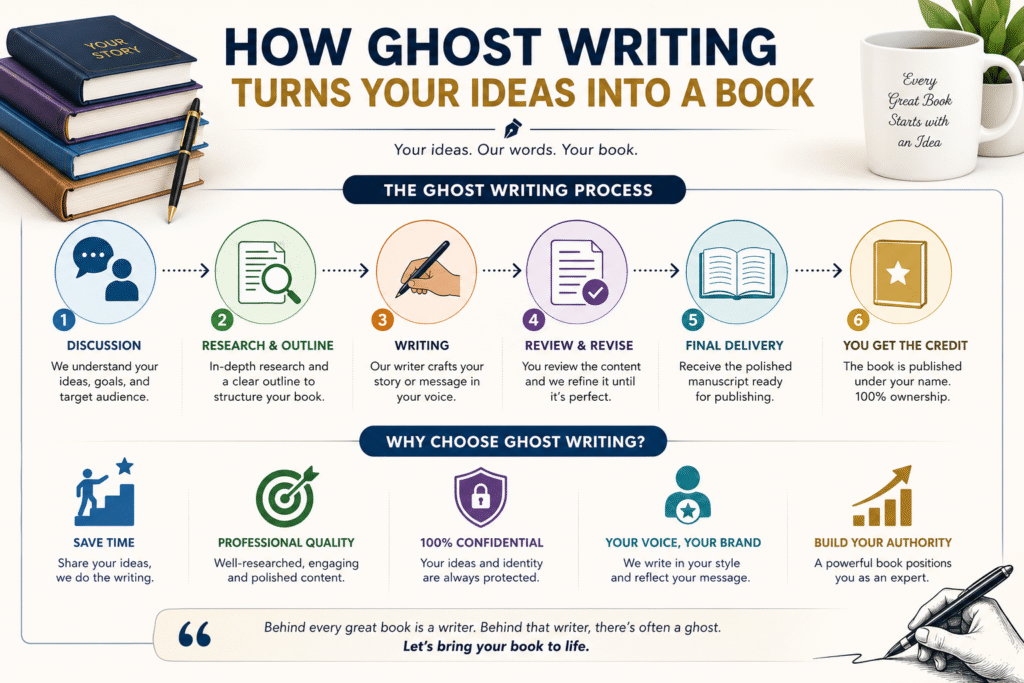
How Does Ghost Book Writing Work?
Many people think ghost book writing is simple.
You share an idea, hire a ghostwriter, and a few weeks later a finished book appears in your inbox.
In reality, it’s a collaborative process. The best books are created when the author and the ghostwriter work together from start to finish.
Here’s what that journey usually looks like.
It Starts with a Conversation
Every book begins with a discussion.
The ghostwriter wants to understand why you want to write the book, who you’re writing it for, and what you want readers to take away after finishing it.
You’ll also talk about your experiences, your expertise, and the stories that make your perspective unique.
At this stage, nothing needs to be perfectly organized. Even if your ideas are scattered across notebooks, voice notes, presentations, or documents, that’s completely normal.
Organizing Your Ideas
Once the initial discussions are complete, the ghostwriter gathers all the available material.
This may include interview transcripts, handwritten notes, research papers, recorded conversations, blog posts, or any other content you’ve already created.
The goal isn’t to start writing immediately.
The first priority is to organize everything into a logical flow so the book has a clear direction from beginning to end.
Creating the Book Outline
Before writing the first chapter, most ghostwriters prepare a detailed outline.
Think of it as the blueprint for your book.
It defines the chapters, the order of topics, and the key points each chapter will cover.
Reviewing the outline early allows you to suggest changes before the writing begins. It’s much easier to adjust the structure at this stage than after several chapters have already been completed.
Writing the Manuscript
With the outline approved, the actual writing begins.
Instead of delivering the entire book at once, most ghostwriters work chapter by chapter. This gives you the opportunity to review each section, share feedback, and make sure the content reflects your ideas accurately.
Regular feedback keeps the project moving in the right direction and reduces the need for major revisions later.
Refining the Content Together
The first draft is rarely the final version.
As you review the manuscript, you may remember additional examples, want to clarify certain ideas, or feel that some sections need a different tone.
This is a normal part of the process.
A professional ghostwriter welcomes constructive feedback and uses it to improve the manuscript while keeping your original message intact.
Completing the Final Manuscript
After revisions are finished, the manuscript is polished and prepared for the next stage.
Once your manuscript is complete, the next step is publishing it professionally. If you’re unsure what comes after writing, our complete guide to the book publishing process explains everything from editing and design to printing, ISBN registration, and distribution.
You’ll also need an ISBN before publishing your book. The official Raja Rammohun Roy National Agency for ISBN provides ISBN registration for authors and publishers in India.
By this point, the book should feel natural, well-structured, and true to your voice.
The goal isn’t for readers to notice the ghostwriter’s work. It’s for them to connect with your ideas, your experiences, and your story.
That’s what successful ghost book writing is all about-a partnership that transforms knowledge into a book without losing the personality of the person behind it.
Copyright, Confidentiality & Ownership in Ghost Book Writing
One of the first questions people ask before hiring a ghostwriter is, “Who owns the book once it’s finished?”
It’s a fair question because a book is more than just a collection of words. It represents your ideas, your experiences, and often years of hard-earned knowledge.
In most professional ghost book writing projects, the finished manuscript belongs to the author. The ghostwriter is hired to write the book on your behalf, but the ownership of the final work is usually transferred to you through a written agreement.
That’s why having a clear contract before the project begins is so important.
For general information about copyright protection in India, authors can also refer to the official website.
Why a Written Agreement Matters
A professional ghostwriting project should never rely on verbal promises alone.
A written agreement helps both the author and the ghostwriter understand their responsibilities from the beginning. It also reduces the chances of confusion later in the project.
The agreement typically covers things like:
- Who owns the completed manuscript
- The scope of the project
- Payment terms
- Number of revisions
- Project timelines
- Confidentiality expectations
Having everything documented allows both parties to focus on the writing instead of worrying about misunderstandings.
Keeping Your Ideas Confidential
Writing a book often involves sharing information that isn’t public yet.
You may discuss business strategies, personal experiences, research findings, or unpublished ideas during interviews with your ghostwriter.
Professional ghostwriters understand the importance of protecting this information.
If confidentiality is a priority, you can include a confidentiality clause or a Non-Disclosure Agreement (NDA) as part of your contract. This provides additional assurance that your ideas and project details will remain private throughout the writing process.
Will the Ghostwriter Receive Credit?
The answer depends on the agreement between both parties.
In many cases, the ghostwriter remains anonymous, and the book is published entirely under the author’s name. This is the traditional approach to ghost book writing.
However, some authors choose to acknowledge the ghostwriter in the book’s acknowledgements section or credit them as a collaborator. Neither approach is right or wrong-it simply depends on what both parties decide before the project begins.
Build the Partnership on Trust
Ghostwriting is built on trust as much as writing skill.
As an author, you’re trusting someone with your ideas and personal experiences. At the same time, the ghostwriter is investing their time and creativity to help shape your vision into a complete manuscript.
When expectations are discussed openly and agreed upon from the beginning, the entire process becomes smoother, more transparent, and far more enjoyable for everyone involved.
Common Myths About Ghost Book Writing
Ghost book writing has become more common over the years, but there are still plenty of misconceptions about how it works.
Many people hesitate to hire a ghostwriter simply because they’ve heard inaccurate information or made assumptions about the process.
Let’s clear up some of the most common myths.
Myth 1: Ghost Book Writing Is Cheating
This is probably the biggest misconception.
A ghostwriter doesn’t invent your experiences or claim your achievements. They help organize your ideas and present them in a way that’s engaging for readers.
The knowledge, stories, and insights still come from you.
Think of it like working with an architect to design your dream home. The architect brings technical expertise, but the vision is still yours.
Myth 2: Only Celebrities Use Ghostwriters
While celebrities often work with ghostwriters, they aren’t the only ones.
Today, entrepreneurs, business owners, doctors, professors, coaches, consultants, and researchers also choose ghost book writing to share their expertise.
Many professionals simply don’t have the time to write a book on their own, even though they have valuable knowledge to offer.
Myth 3: A Ghostwriter Will Change My Voice
A good ghostwriter does exactly the opposite.
Their job is to understand how you think, speak, and explain ideas. Instead of replacing your voice, they try to preserve it throughout the manuscript.
Readers should feel like they’re hearing your thoughts-not someone else’s.
That’s why interviews, feedback sessions, and regular discussions are such an important part of the process.
Myth 4: I Need a Complete Manuscript Before Hiring a Ghostwriter
Many first-time authors believe they need to write most of the book before seeking professional help.
That’s not true.
Some authors approach a ghostwriter with detailed notes, while others have nothing more than an idea and a clear goal.
A professional ghostwriter can help organize scattered thoughts, identify the right structure, and turn rough concepts into a complete manuscript.
Myth 5: AI Can Replace Ghost Book Writing
AI writing tools have made content creation faster, but writing a book is very different from generating a few paragraphs.
A book requires personal experiences, emotional depth, critical thinking, and a consistent voice from the first chapter to the last.
AI can assist with brainstorming or organizing ideas, but it can’t interview you, understand your life experiences, or capture the subtle details that make your story unique.
That’s why many authors use AI as a supporting tool while still relying on a professional ghostwriter to create a manuscript that feels authentic and personal.
The Reality
Ghost book writing isn’t about taking shortcuts or hiding the truth.
It’s a professional collaboration between someone with valuable ideas and someone with the writing expertise to shape those ideas into a compelling book.
When both work together, the result is a book that informs, inspires, and genuinely connects with readers.
How to Choose the Right Ghostwriter for Ghost Book Writing
Choosing a ghostwriter is about more than finding someone who can write well. You’re looking for a professional who can understand your ideas, ask the right questions, and turn your thoughts into a book that feels like it was written by you.
Taking a little extra time before making your decision can save you from unnecessary revisions, delays, and disappointment later.
Look for Someone Who Understands Your Subject
Every book is different.
A memoir requires a different approach than a business book, and an academic title isn’t written the same way as a self-help guide.
Ask potential ghostwriters if they’ve worked on similar projects before. They don’t need to have written books in your exact niche, but they should be comfortable understanding new topics and explaining them clearly.
Their ability to learn and adapt is often just as important as their writing skills.
Ask About Their Working Process
Every ghostwriter has a different way of working.
Some prefer interviews, while others work from notes, presentations, or voice recordings. Some share chapters one at a time, while others submit larger sections for review.
Understanding their process helps you know what to expect throughout the project.
Don’t hesitate to ask questions like:
- How will we communicate during the project?
- How often will I receive drafts?
- How are revisions handled?
- What information do you need from me before writing begins?
Clear answers usually indicate a well-organized workflow.
Review Their Previous Work
Before hiring anyone, spend some time reading samples of their writing.
Pay attention to whether the content feels natural, easy to follow, and engaging. Good writing isn’t about using difficult words-it’s about making ideas clear and enjoyable to read.
If their previous work holds your attention, there’s a good chance they’ll be able to do the same for your readers.
Don't Make Price Your Only Decision
Ghost book writing is an investment, not just another service.
While it’s natural to compare prices, choosing a ghostwriter solely because they offer the lowest quote may not lead to the best outcome.
Instead, think about the value they bring.
An experienced ghostwriter may charge more because they invest time in understanding your voice, conducting interviews, organizing your ideas, and refining every chapter. That extra effort often results in a stronger manuscript.
Build a Relationship Based on Trust
You’ll be sharing your ideas, experiences, and sometimes even personal stories.
That’s why trust matters.
Choose someone who listens carefully, communicates openly, and welcomes your feedback. If conversations feel comfortable from the beginning, the writing process is usually much smoother.
A successful ghostwriting project isn’t built on contracts alone-it’s built on collaboration.
A Few Mistakes to Avoid
Before you make your final decision, keep these common mistakes in mind:
- Hiring someone without reviewing their previous work.
- Choosing the lowest price without considering quality.
- Starting the project without a written agreement.
- Expecting the ghostwriter to work without regular feedback.
- Rushing the writing process to meet unrealistic deadlines.
Avoiding these mistakes can save both time and frustration.
Make the Right Choice
The right ghostwriter won’t simply write a manuscript-they’ll help shape your ideas into a book that reflects your personality, knowledge, and purpose.
When you find someone who understands your vision and communicates openly, the journey becomes far more enjoyable. Instead of worrying about the writing process, you can focus on sharing what matters most-your story and the value you want readers to take away.
Ghost Book Writing (FAQs)
Is ghost book writing legal?
Yes. Ghost book writing is a completely legal and widely accepted professional service. The relationship between the author and the ghostwriter is governed by a written agreement that defines ownership, confidentiality, payment, and other project terms.
Can I publish a ghostwritten book under my own name?
In most cases, yes.
A ghostwriter is hired to help write the manuscript, while the book is published under the author’s name. The exact ownership and credit arrangements should always be discussed and documented before the project begins.
How long does ghost book writing take?
The timeline depends on the type of book, its length, and how quickly feedback is shared.
A shorter book may take a few months, while a detailed business book, memoir, or research-based manuscript can take longer. Regular communication between the author and the ghostwriter usually helps keep the project on schedule.
Do I need to have everything planned before hiring a ghostwriter?
Not at all.
Many authors begin with nothing more than an idea, a few notes, or years of experience they want to share. A ghostwriter helps organize those thoughts, create a structure, and gradually develop them into a complete manuscript.
How do I know if ghost book writing is right for me?
If you have valuable knowledge, an inspiring story, or professional expertise but struggle to find the time or confidence to write a book yourself, ghost book writing can be a practical solution.
It allows you to focus on sharing your ideas while a professional writer helps transform them into a polished manuscript.
Conclusion
Every book begins with an idea, but turning that idea into a finished manuscript takes time, planning, and consistent effort. That’s why many entrepreneurs, educators, professionals, and first-time authors choose ghost book writing as a practical way to bring their stories and expertise to life.
Working with a ghostwriter doesn’t mean giving up ownership of your book. It means partnering with someone who can organize your thoughts, strengthen your message, and create a manuscript that reflects your unique voice.
If you’ve been waiting for the “perfect time” to start writing, don’t let a lack of time or writing experience hold you back. The most important step is simply getting started.
Ready to Turn Your Idea Into a Book?
Whether you’re writing your first book, documenting your professional expertise, or sharing your life story, AGPH Books can help you through the ghost book writing process with experienced writers and a collaborative approach.
Have an idea? Let’s turn it into a professionally written manuscript that readers will remember.