
We often think that a successful life means having a good career, earning well, staying comfortable and achieving our goals. These things are important, but there is another question that is easy to ignore: Are we actually living a happy and balanced life?
A person may have a good job but still feel stressed. Someone may have plenty of material comforts but struggle with relationships. We may have excellent technical knowledge, yet find it difficult to make the right decision when emotions, pressure or personal interests are involved.
This is where Universal Human Values becomes important.
Universal Human Values is not only about learning what is right and wrong. It is about developing the understanding needed to live with clarity, responsible behaviour and harmony. The book connects value education with personal development, relationships, society, nature and professional ethics.
It also looks at some very basic questions: What do we really want in life? What makes us happy? How should we treat other people? What is our responsibility towards nature? And how can we bring values into our professional life?
In this article, we will explore these ideas in simple language and understand why human values matter not only in education, but also in everyday life and the workplace.
What Are Universal Human Values?
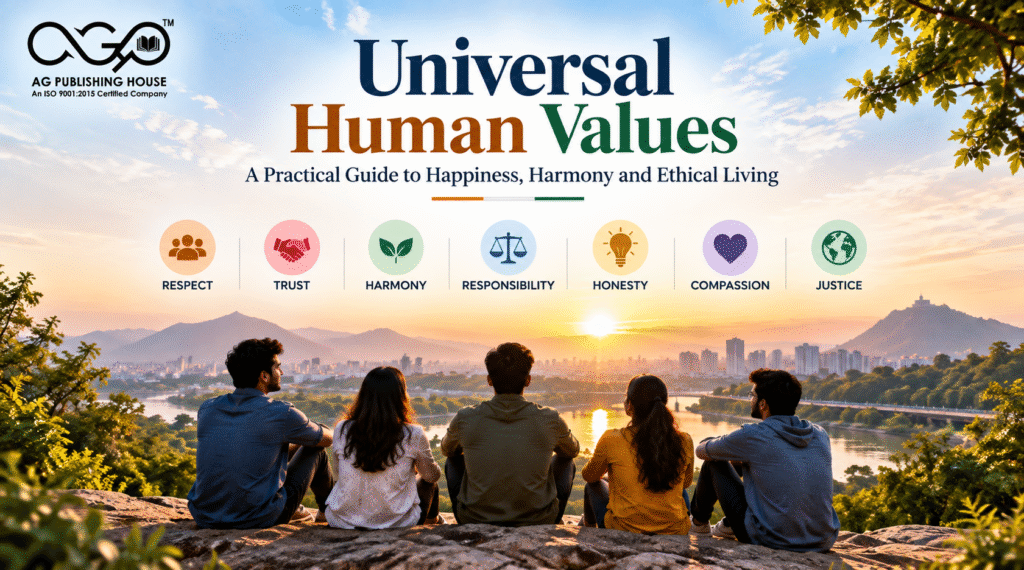
Universal Human Values are the values that help a person live with clarity, responsibility, mutual respect and harmony. They are not limited to one profession, culture or situation. The basic idea is that certain values are important for a meaningful human life and healthy relationships with others.
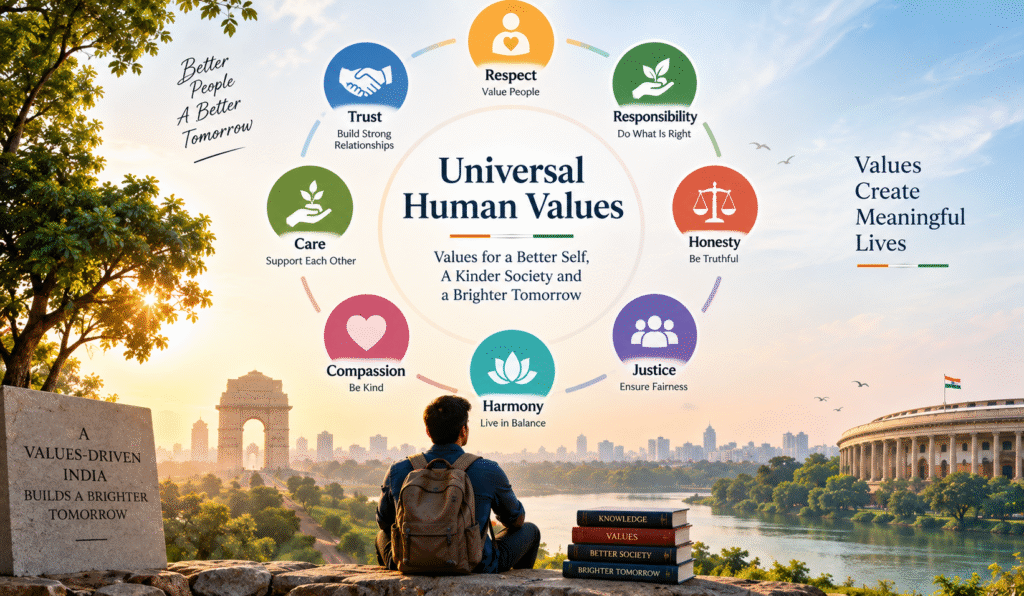
Some simple examples are honesty, respect, responsibility, compassion, justice, trust and self-direction. These values influence how we think, how we treat people and how we make decisions. The book explains that human values help us distinguish between right and wrong while supporting personal well-being, social harmony and responsible living.
What Does “Universal” Mean?
The word universal means that these values are relevant to human beings in general. For example, trust is important in a family, but it is equally important between colleagues. Respect matters between friends, but it also matters between a manager and an employee.
The same principle can apply in different situations even though the circumstances may change.
This is why Universal Human Values are not simply a list of instructions telling us what to do. They encourage us to develop right understanding so that our actions come from awareness rather than pressure, fear or blind following.
Values Are More Than Rules
Rules tell us what we are expected to do. Values help us understand why a particular action is right or responsible.
For example, a company may have a rule against sharing confidential information. Following the rule is important, but understanding responsibility and trust helps a professional follow it even when nobody is watching.
In this sense, values become part of our character. Honesty, discipline, sincerity, patience and integrity are developed through continuous practice in everyday life.
So, human values are not only about being a “good person.” They influence our relationships, decisions, professional conduct and responsibility towards society and nature.
That makes them relevant not just in personal life, but also in education, workplaces and professional ethics.
Why Do We Need Value Education Today?
We live in a time of remarkable progress. Technology has made communication faster, education more accessible and many aspects of life more comfortable. Yet, having more information and better facilities does not automatically mean that we know how to live well.
Many people continue to experience stress, anxiety, relationship conflicts and dissatisfaction even after achieving things they once wanted. The book points to a gap between external progress and inner well-being.
Success Is Not Always the Same as Fulfilment
Modern life often encourages us to focus on achievement—better marks, a better job, more money, more recognition or a higher position.
There is nothing wrong with wanting growth. The problem begins when we pursue these things without understanding what actually gives lasting fulfilment. This can lead to comparison, competition and the constant feeling that something more is still needed.
The Gap Between Knowing and Living
Another important reason for value education is the difference between what we know and how we behave.
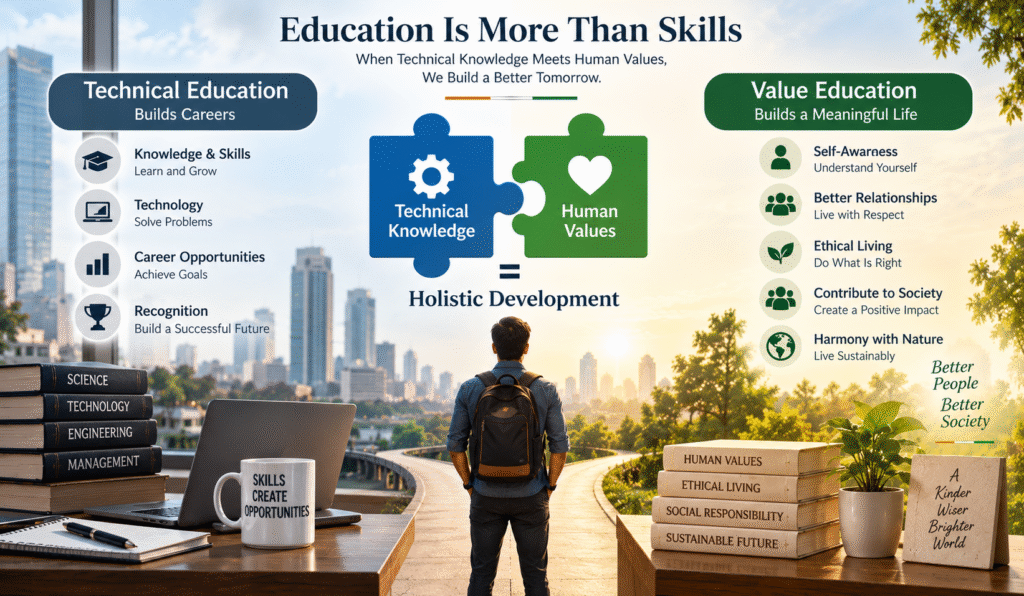
A person may know that honesty is important but still hide a mistake. A professional may understand responsibility but ignore the impact of a decision on others. Technical education can teach us how to do something, but values help us think about how it should be done.
Value education aims to connect knowledge with thought, behaviour and action, making our decisions more consistent with our understanding.
Building a More Balanced Life
Value education is therefore not about adding another subject to education. Its broader purpose is to develop a person who can live with right understanding, healthy relationships and responsible use of physical resources.
It encourages clarity about ourselves, better relationships based on trust and respect, and responsible coexistence with society and nature.
In simple words, value education helps us understand not only how to succeed, but also how to live with balance and purpose.
Happiness and Prosperity: What Are We Really Looking For?
Most of us want the same basic things from life: happiness and prosperity. We may choose different careers, lifestyles or goals, but behind many of these choices is the desire to live peacefully and have enough resources for a comfortable life.
The challenge is that we often misunderstand what happiness and prosperity actually mean.
Happiness Is More Than Temporary Pleasure
A new phone, a holiday, praise at work or achieving a goal can make us feel good. But these experiences usually change with time. Once the excitement fades, we start looking for the next thing that will make us feel good.
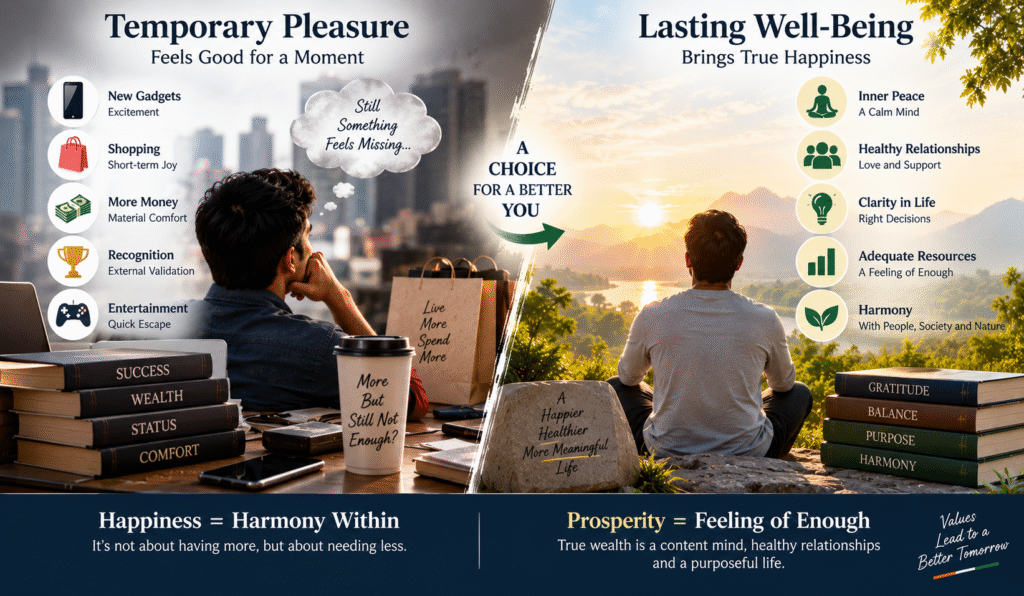
In Universal Human Values, happiness is understood as harmony within the self, rather than simply experiencing temporary pleasure. When there is clarity in our thoughts and expectations, we experience greater inner stability.
This does not mean that material comforts or enjoyable experiences are unimportant. It means they should not be mistaken for the complete source of happiness.
What Is Prosperity?
Prosperity is also commonly confused with having more and more money or possessions.
The book presents prosperity as the feeling of having enough physical facilities to meet our needs. It is different from endlessly accumulating things.
For example, having enough food, clothing, a suitable home and other necessary facilities can fulfil physical needs. But continuously comparing our lifestyle with others and wanting more simply because someone else has more can create dissatisfaction.
Finding the Right Balance
This is where right understanding becomes important. We need to recognize the difference between what the self needs and what the body needs, between lasting happiness and temporary pleasure, and between prosperity and accumulation.
The book connects these ideas through a simple approach: right understanding → right relationships → adequate physical facilities → harmony in the individual, family, society and nature.
So, the goal is not to reject success or material facilities. It is to understand their proper place in life.
True well-being comes from having clarity within, healthy relationships around us and enough physical resources to live responsibly.
Self-Exploration and Right Understanding
We often make decisions based on what others tell us – family expectations, social pressure, trends, past experiences or what seems successful at the moment. But an important question remains: Do we actually understand why we are making these choices?
This is where self-exploration becomes important.
What Is Self-Exploration?
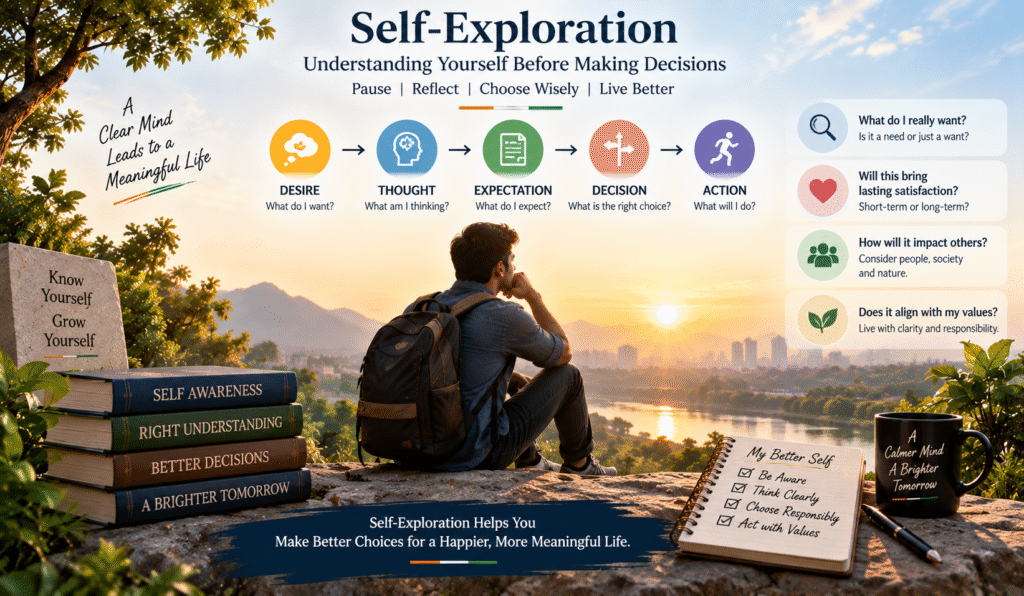
Self-exploration means looking within ourselves and understanding our own thoughts, desires, expectations and actions. It is not simply reading about values or accepting someone else’s ideas. It involves observing ourselves and checking whether an idea actually makes sense in our own life.
For example, suppose you want a higher-paying job. Instead of automatically assuming that more money will make you happier, self-exploration encourages you to ask:
- What am I actually looking for?
- Is this a genuine need or a comparison with others?
- Will this choice bring lasting satisfaction?
- What impact will it have on my relationships and well-being?
These questions can reveal the difference between what we want at a particular moment and what we actually consider meaningful.
The Role of Natural Acceptance
Self-exploration also involves understanding our natural acceptance – our inner ability to examine whether something feels naturally right and harmonious rather than simply accepting it because of external pressure.
The book describes natural acceptance as an internal reference point for evaluating thoughts and actions. It is presented as something that helps us distinguish what is naturally appropriate from what is externally conditioned.
Understanding Desire, Thought and Expectation
Our inner activity can also be understood through three connected processes: desire, thought and expectation. A desire creates an intention, thought helps us evaluate possibilities, and expectation relates to the result we imagine. When these are unclear or contradictory, frustration and dissatisfaction can follow.
Right understanding helps bring clarity to this process. It helps us understand ourselves, our relationships and our place in society and nature, leading to more balanced decisions.
In simple terms, self-exploration helps us stop living only by habit or pressure and start making choices with greater awareness.
Understanding the Self and the Body
One of the important ideas in Universal Human Values is understanding the difference between the self and the body.
We often use the word “I” for everything – our thoughts, emotions, decisions and physical body. But these are not exactly the same. The book explains the human being as the co-existence of the self and the body, with the body functioning as an instrument for the self.
The Self and the Body Have Different Needs
The body has physical needs such as food, clothing, rest, shelter and healthcare. These needs are generally measurable and can be fulfilled through physical facilities.
The self, on the other hand, deals with desires, thoughts, feelings and expectations. It seeks qualitative things such as happiness, trust, respect and meaningful relationships.
The problem begins when we try to fulfil the needs of the self only through physical facilities.
For example, buying something new may provide temporary pleasure, but it cannot automatically create trust in a relationship or bring lasting inner clarity.
Why This Understanding Matters
When we clearly understand the needs of both the self and the body, our priorities become more balanced.
We can take care of our health and physical requirements without making material possessions the measure of our entire well-being. At the same time, we can give attention to our thoughts, relationships and inner development.
This distinction is an important part of holistic development, where the goal is harmony within the self, healthy relationships with others and responsible use of physical resources.
In simple terms, a balanced life requires us to take care of both the body and the self, while understanding that their needs are different.
Human Relationships and Social Harmony
No matter how successful or independent we become, relationships remain an important part of life. Our happiness is influenced not only by what we achieve, but also by how we connect with our family, friends, colleagues and society.
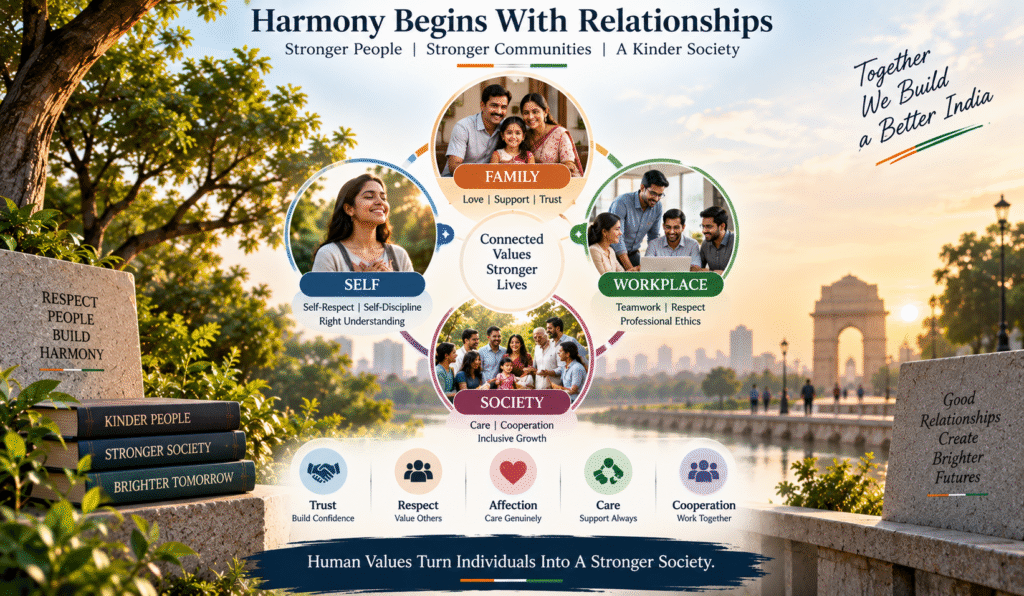
This is why human values in relationships are an important part of value education. Values such as trust, respect, affection, care, guidance, gratitude and love provide a foundation for healthy and meaningful relationships.
Trust and Respect Come First
Trust creates confidence in a relationship. When people believe that others are honest and reliable, communication becomes easier and conflicts can be reduced. Trust also supports cooperation in families, workplaces and society.
Respect is equally important. It means recognizing the dignity and value of another person, even when their opinions or experiences are different from ours. A respectful environment encourages better communication, patience and mutual understanding.
From Family to Society
Healthy relationships do not stop at the family level. When trust, respect and cooperation become part of our interactions, they can gradually contribute to social harmony.
For example, a disagreement at home does not always need to become an argument. Listening carefully, understanding the other person’s concern and responding respectfully can change the entire situation.
The same approach works at work. A team where people trust, respect and support one another is more likely to communicate openly and work together effectively.
The Role of Affection, Care and Guidance
Relationships also need emotional connection. Affection creates a sense of belonging, while care provides support when someone is facing difficulties. Guidance helps people make better decisions and develop responsibility.
These values help reduce unnecessary conflict and strengthen emotional stability.
The larger idea is simple: harmony within the individual supports harmony in relationships, and harmony in relationships contributes to harmony in society. Value education therefore looks beyond individual success and encourages us to build a life where our well-being and the well-being of others can exist together.
Living in Harmony With Nature
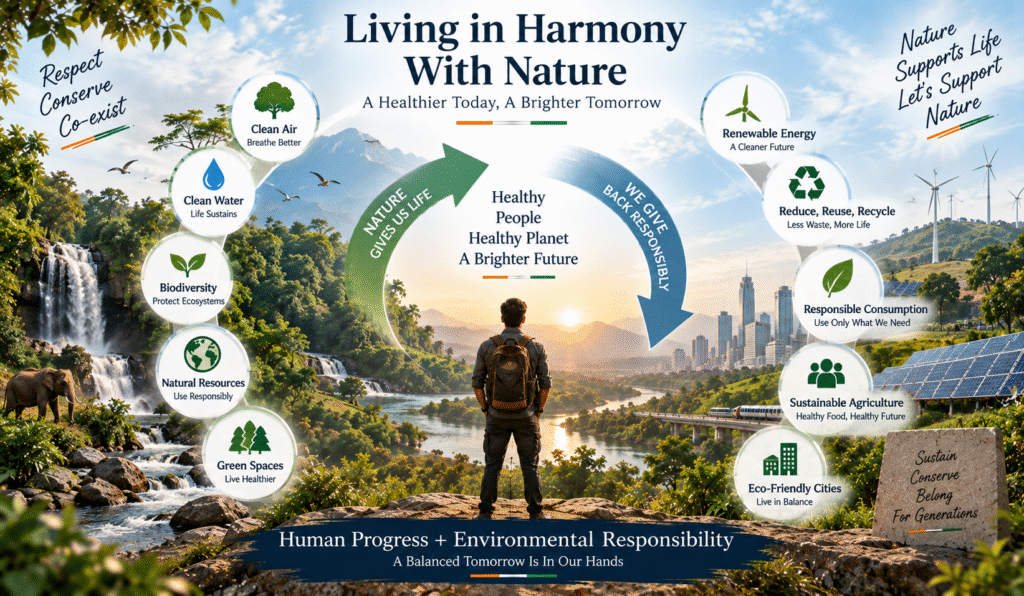
We often think of nature as something outside us – forests, rivers, animals, soil and the environment around us. But Universal Human Values presents a broader view: human beings are an integral part of nature and depend on it for basic needs such as food, water, air and physical resources.
What Does Co-Existence With Nature Mean?
Co-existence means living together in a way that supports balance, mutual fulfilment and sustainability. Nature itself works through interconnected systems. Soil supports plants, plants support animals, and these systems continuously interact with one another.
The problem arises when human needs turn into excessive consumption and exploitation. Pollution, resource depletion and environmental damage are examples of what happens when we ignore this interconnectedness.
Our Responsibility Towards Nature
Human beings have the ability to understand these relationships and consciously change the way we use resources. Instead of treating nature only as a source of materials, we can use resources responsibly and design systems that reduce waste and environmental damage.
This can be as simple as avoiding unnecessary consumption, saving water and energy, reducing waste or choosing more sustainable practices in our work and daily life.
The book connects environmental harmony with responsible resource use, protection of nature and sustainable practices. Such an approach helps maintain ecological balance and ensures that resources remain available for the future.
So, living in harmony with nature does not mean giving up development. It means making development responsible enough that human progress and environmental well-being can exist together.
Universal Human Values in Professional Life
A professional is expected to have knowledge, skills and the ability to solve problems. But is technical competence alone enough?
Imagine an engineer who can design an efficient system but ignores its environmental impact. Or a manager who achieves business targets by hiding important information from employees. In both cases, the person may be professionally capable, but something is missing.
That missing element is ethical responsibility.
Technical Skills Need the Support of Values
Human values in professional life help us decide how our knowledge and skills should be used. The book explains that professional competence is not limited to technical knowledge. It also includes ethical understanding, responsibility and the ability to use professional knowledge for human welfare.
This means a professional should think beyond questions such as “Can I do this?” and also consider “Should I do this?”
For example, a technology professional may have the ability to collect large amounts of user data. But honesty, responsibility and concern for others should guide how that data is handled.
Honesty, Justice and Responsibility at Work
Professional ethics becomes meaningful when values are reflected in everyday decisions.
Honesty means communicating truthfully and avoiding deception. Responsibility means considering the consequences of our actions. Justice and fairness mean treating people without exploitation or discrimination.
These values can improve trust within teams and create a healthier professional environment. The book connects ethical professional conduct with transparency, accountability, justice and responsible decision-making.
Profession as Participation in Society
Our professional decisions rarely affect only us. A product, service, technology or business decision can influence customers, employees, communities and the environment.
This is why professional work can be viewed as a form of participation in society and nature. The goal should not be limited to profit or personal success. Professional activities should also contribute to human welfare, ecological balance and long-term sustainability.
In simple terms, a truly competent professional is not only someone who knows how to do the job, but someone who understands how to do it responsibly.
From Technical Skills to Ethical Professionalism
Technical knowledge tells us what we can do. Human values help us understand how we should do it responsibly.
In professional life, this difference matters. A technically correct decision can still create problems if it ignores people, society or the environment.
For example, an engineer may be able to develop a cheaper production process, but should also consider whether it creates unnecessary pollution. Similarly, a manager may have the authority to make a decision, but should consider whether it is fair to the people affected by it.
Moving Beyond “Can I?” to “Should I?”
Ethical professionalism means using professional knowledge with responsibility, honesty, fairness and concern for human welfare.
The book explains that professional competence becomes complete when technical skills are integrated with ethical understanding and responsible action.
This does not mean choosing ethics instead of performance. It means bringing both together.
A good professional should aim for efficiency with responsibility, success with integrity and innovation with sustainability.
When values guide technical skills, professional work can contribute not only to organisational success but also to the well-being of people and the environment.
Practical Ways to Apply Human Values in Daily Life
Understanding Universal Human Values is useful only when it becomes part of our everyday behaviour. We do not need to make dramatic changes. Small, conscious choices can gradually bring more clarity and harmony into life.
1. Pause Before You React
When you are angry, stressed or disappointed, take a moment before responding. Ask yourself what you are actually feeling and what outcome you want.
This simple pause can prevent unnecessary arguments and help you respond with greater clarity.
2. Question Your Assumptions
Instead of immediately believing every thought or expectation, examine it.
Ask: Is this really what I need, or am I influenced by comparison, pressure or habit? This practice supports the process of self-exploration and natural acceptance described in the book.
3. Separate Needs From Wants
Physical facilities are necessary, but continuously wanting more does not necessarily create happiness. Understanding the difference between genuine needs and endless accumulation can help us use resources more responsibly.
4. Practice Trust and Respect
Give people the space to express themselves. Listen before judging, communicate honestly and treat others with dignity. Trust, respect, affection and care form the foundation of harmonious relationships.
5. Bring Values Into Professional Decisions
Before making an important professional decision, consider not only efficiency or profit, but also fairness, responsibility, people and environmental impact.
This is how values move from being an idea we learn to becoming a way we live.
Frequently Asked Questions About Universal Human Values
What are Universal Human Values?
Universal Human Values are values that support right understanding, responsible behaviour and harmony in individual life, relationships, society and nature. They include qualities such as trust, respect, responsibility, justice and care.
Why are Universal Human Values important?
They help us make better decisions, develop healthier relationships and understand the difference between temporary pleasure and lasting happiness. The book connects value education with inner clarity, responsible living and harmonious development.
What is value education?
Value education is the process of developing right understanding and ethical conduct along with knowledge and skills. Its purpose is not simply to teach moral rules, but to help individuals understand what is valuable and apply that understanding in daily life.
What is self-exploration?
Self-exploration means examining our own thoughts, desires, expectations and actions instead of accepting everything blindly. It helps us understand what is naturally acceptable and what contributes to lasting happiness and harmony.
What is the difference between happiness and prosperity?
In UHV, happiness (Sukh) refers to harmony and satisfaction within the self, while prosperity (Samriddhi) refers to the feeling of having enough physical facilities. Both are considered basic human aspirations.
Are human values useful for students?
Yes. Human values can help students develop self-awareness, responsible behaviour, healthy relationships and ethical decision-making alongside their academic and technical education. The book specifically connects value education with both personal and professional development.
How do human values help engineers and professionals?
Technical skills become more meaningful when guided by ethical understanding. For professionals, this means considering honesty, responsibility, fairness, human welfare and environmental sustainability while making decisions.
How are Universal Human Values connected with professional ethics?
The connection is direct. The book presents professional competence as a combination of technical capability and ethical responsibility. It also highlights transparency, accountability, justice, fairness and mutual benefit as important aspects of professional ethics.
Overall, Universal Human Values are not limited to what we learn—they are about how that understanding becomes visible in the way we think, relate, work and live.
Conclusion
Universal Human Values remind us that a meaningful life is not built only through achievement, money or technical skills. It also requires right understanding, healthy relationships, responsible use of resources and ethical conduct.
The journey begins with self-exploration. As our understanding becomes clearer, it can influence how we treat others, how we work and how we interact with nature. The book ultimately connects these levels of harmony from the individual and family to society and nature – with the larger goal of continuous happiness, prosperity and responsible living.
In a world where professional skills and technology are advancing rapidly, human values provide an important foundation for using that progress wisely.
True development is not only about becoming more capable. It is about becoming capable of creating harmony – for ourselves, for others and for the world around us.